-
CALL US:
- (866) 952-3456

Look at that small backyard of yours. If you’re staring out the window wondering if a swing set is even in the cards, you're not the only one. It’s a common belief that a tight space automatically rules out one of the best parts of outdoor childhood fun.
Good news: that’s just not true anymore.
The market for children's outdoor swings has swelled to a staggering USD 5.23 billion worldwide. That’s a huge number, and it tells us one thing loud and clear—families everywhere are making outdoor play a top priority. This demand has lit a fire under manufacturers, pushing them to get creative and design clever, space-saving swing sets that don't skimp on fun or safety, even for smaller yards.
Instead of seeing your yard's size as a dead end, think of it as a design challenge. It’s all about shifting your perspective. Don't focus on what you can't fit; get excited about what you can create with a little smart planning. Making the most of the space you have often comes down to some thoughtful landscape design ideas for small yards. This guide is your complete game plan for turning that little patch of green into a full-blown adventure zone.
We’re going to walk you through everything you need to know:
The right approach isn’t about shrinking the fun; it's about choosing equipment that is intelligently designed for the space you have. With careful selection, even the smallest backyards can host big adventures.
So, let's ditch the idea that limited square footage means limited play. By the time you're done here, you’ll have a clear, simple roadmap to picking, installing, and enjoying the perfect swing set for your family.
Before you even start browsing for a swing set and fall in love with a particular design, the real work begins right in your own backyard. Your first and most important tool isn't a web browser—it's a tape measure. Mapping out your space is about much more than just seeing if the swing set's footprint will fit; it's about making sure you’re creating a play zone that’s actually safe and fun for your family.
Think of it this way: every single swing set requires a safety use zone. This is essentially an invisible bubble that has to surround the entire structure, and it must be completely free of any obstructions. For anyone choosing a swing set for a small backyard, this safety zone is the single biggest factor to consider, because it dictates whether there’s enough room for kids to swing high and land safely without hitting anything.
Start by getting the exact length and width of the flattest, most open spot in your yard. This is a time for precision, not guesswork! Eyeballing it now can lead to some major headaches and disappointment later. Once you have those core numbers, you need to scout for obstacles that will inevitably shrink that space.
Look out for things like:
Once you’ve accounted for these, you'll have a much more realistic picture of your usable footprint—which is almost always a lot smaller than you initially thought. A great trick is to use some simple stakes and string to physically outline the potential swing set area plus its safety zone. This gives you a tangible visual of just how much space the whole setup will actually command.
This whole process breaks down into three simple steps: measure your yard, define the safety zone, and then—and only then—choose the right set for the space you actually have.
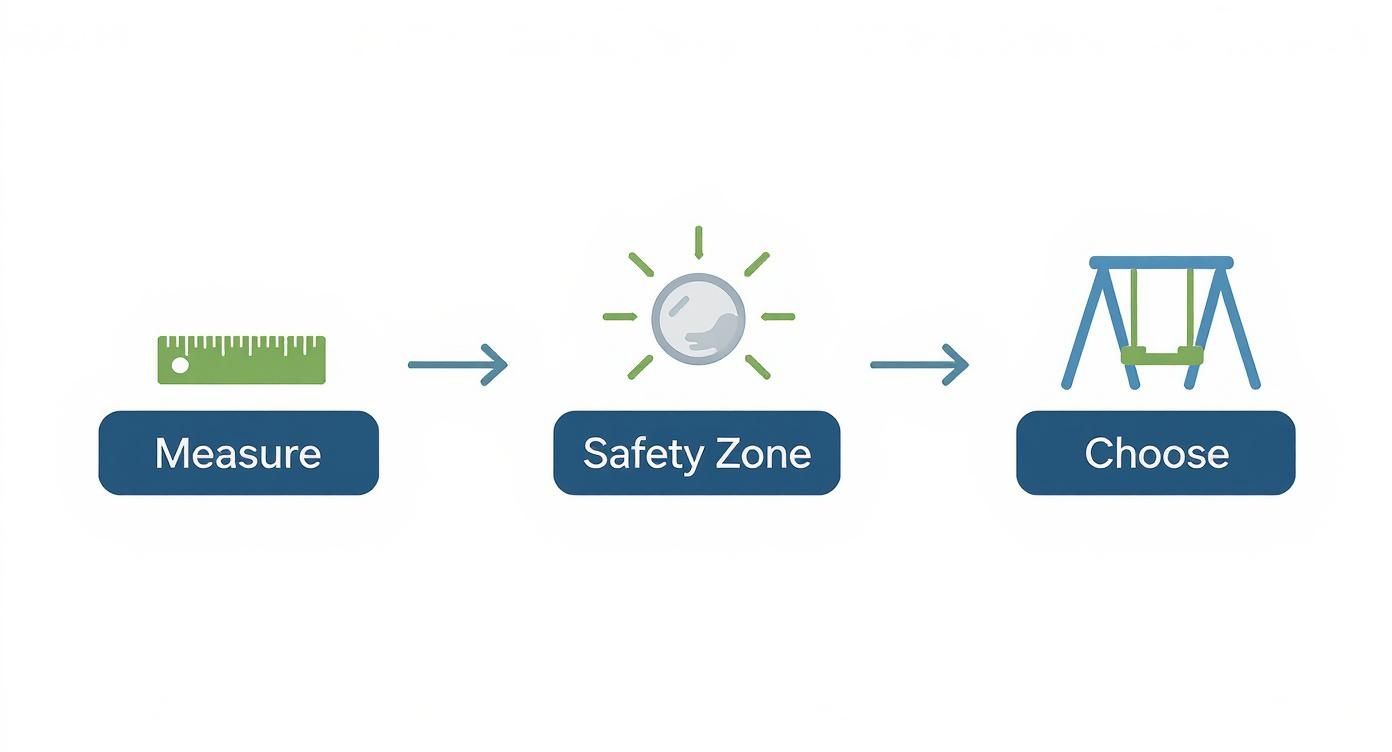
As you can see, picking out the swing set is the very last step. It only happens after you’ve done your homework and confirmed your space and safety clearances are good to go.
A crucial part of this planning stage is ensuring your ground is perfectly flat. A level surface is non-negotiable for stability and safety, as even a minor slope can compromise the entire structure.
If your chosen spot isn't perfectly level, don't sweat it—it's a pretty common problem for homeowners. We've got you covered. Check out our guide on how to level the ground for a swing set to walk through the proper techniques for creating a safe, solid foundation. Taking these planning steps seriously is what guarantees your final choice will be both a blast for the kids and fundamentally secure.

Okay, you’ve mapped out your usable space and you know exactly how much room you have to work with. Now for the fun part—picking out the actual swing set! But when every square foot is precious, you quickly realize not all designs are created equal. The best swing sets for small yards are the ones built specifically with a compact footprint in mind, squeezing the most play value into the smallest possible area.
You're not alone in looking for a space-conscious option. The demand has exploded, and the playground sets market in the United States is now valued at a whopping USD 912.79 million, with swings leading the charge as the most popular feature. This has pushed manufacturers to get creative, designing smart, affordable models that bring the joy of a playground to even the coziest backyards. If you want to dive deeper into the market trends, you can explore detailed insights on deepmarketinsights.com.
To help you sort through the options, let's break down the most common types you'll encounter.
When you picture a swing set, the traditional A-frame is probably what comes to mind. That iconic triangular shape is incredibly stable by design, making it a reliable and wildly popular choice for generations. These are a fantastic fit for long, narrow yards where you have more length than width to play with.
Both wood and metal A-frames deliver a straightforward, classic swinging experience, but their entire footprint is pretty much dedicated to just that one activity.
If you want the most bang for your spatial buck, the all-in-one compact playset is a total game-changer. The strategy here is simple: build up, not out. These brilliant multi-function units cleverly pack several activities into one consolidated structure.
These playsets are the ultimate space-savers. They combine a swing beam with features like a small fort, a slide, and even a rock-climbing wall, packing a playground's worth of fun into a footprint that might otherwise only fit a basic swing.
This vertical approach is perfect for square or awkwardly shaped yards where a long, single-purpose swing beam just won't work. The key is to double-check the total dimensions, especially where the slide ends, to make sure the whole thing fits comfortably inside your safety zone.
What if your space is really tight? Don't worry, there are minimalist designs that can be the perfect solution. A single-post swing, for instance, uses one central vertical pole to support the swing beam. This design dramatically shrinks the ground footprint compared to a traditional A-frame.
Similarly, simple freestanding swing frames designed for just one or two swings are an excellent choice. They deliver that core swinging experience without the extra bulk of a full playset. These are ideal when your main goal is giving your kid a place to swing, and you just don't have the real estate for slides or forts. As a bonus, they're often much easier to assemble and can even be moved if needed.
To make it even clearer, here’s a side-by-side look at how these different types stack up. Think of this as your cheat sheet for matching a swing set to your specific backyard.
| Swing Set Type | Typical Footprint | Key Features | Best For |
|---|---|---|---|
| A-Frame Swing Set | Long and narrow (e.g., 8' x 12') | 2-3 swings, simple frame, classic look | Yards with more length than width; focused on swinging |
| All-In-One Playset | Square or rectangular (e.g., 10' x 10') | Swings, slide, fort, climber combo | Maximizing activities in a small, square-ish area |
| Single-Post Swing | Extremely small (e.g., 5' x 8') | One or two swings, minimal ground contact | Tiny yards, patios, or when space is the top priority |
| Freestanding Swing | Small and focused (e.g., 6' x 8') | 1-2 swings, lightweight and often portable | Renters or anyone needing a simple, non-permanent option |
Ultimately, the right choice comes down to the shape of your yard and what you want to get out of it. An A-frame is perfect for pure swinging, while a compact playset offers a variety of fun in one tidy package.
Alright, we've walked through how to measure your space and the different types of swing sets out there. Now for the fun part: let's look at some specific models that really nail the small-yard challenge. We've handpicked a few winners that solve the most common space problems, focusing on smart design, solid construction, and packing the most fun possible into a tiny footprint.
Backyard Discovery Buckley Hill
The Buckley Hill is a fantastic example of a smart, linear layout. It’s an all-in-one playset that stretches lengthwise, making it the perfect solution for those long, skinny side yards or narrow rectangular spaces. Even with a modest 8 ft x 8 ft footprint, it cleverly fits in two swings, a slide, and a little upper fort.
The design just works. It keeps all the action lined up along a single axis, so you get the feel of a full playset without the sprawling, square shape that would otherwise eat up your entire lawn. It’s a brilliant way to transform a tricky patch of grass into a full-blown play zone.
Gorilla Playsets Outing III
What if your yard is more of a square? When you can't build out, you build up. That's exactly what the Gorilla Playsets Outing III does. It’s built around a compact tower that features a rock wall and a slide, with the swing beam extending off to one side.
This vertical approach is a total game-changer for those boxy, oddly-shaped backyards. By stacking the play features, it frees up a ton of open ground for kids to run around or for you to do other things with your yard. Plus, this model is well-known for its high-quality cedar construction, which is always a popular choice.
In fact, wooden swing sets are a huge deal right now, holding a market share valued at USD 0.17 billion. That accounts for 42% of the total market, which tells you just how much people still prefer the classic, sturdy look of wood. With more and more homes having smaller yards, manufacturers are stepping up with compact wooden designs to meet that growing demand.
Sportspower My First Metal Swing Set
Look, sometimes you just don’t have the room for a fort or a slide, and that’s perfectly fine. When every single inch counts, a simple set like the Sportspower My First Metal Swing Set can be a lifesaver. It’s a no-frills, A-frame design that delivers the pure joy of swinging in an incredibly compact package.
These sets usually come with one or two swings and maybe a small glider, allowing them to tuck into tight corners where nothing else would fit. Since they’re made of metal, they tend to be lightweight—but just remember that secure anchoring is non-negotiable with these models to keep them from tipping over during enthusiastic play.
The real takeaway here is to match the shape of the swing set to the shape of your yard. A long, linear set is the answer for a narrow space, while a vertical, stacked set is perfect for a square one.
Choosing the right model from the start turns all that research into a purchase you can feel good about. If you're still exploring and want a broader look at different play structures, be sure to check out our guide on the best backyard playground equipment for more great ideas. A well-informed decision is the first step toward years of safe, happy memories.

Alright, you've picked out the perfect swing set. But the job isn't quite done. A playset is only as safe as its foundation—meaning the ground underneath it and the anchors holding it down. Getting these two things right is absolutely non-negotiable for a safe play zone, especially in a small backyard where every inch counts.
First things first, let's talk about what's underfoot. Hard-packed dirt, concrete, or even plain old grass just won't cut it. They're dangerous landing zones for the inevitable tumbles that come with energetic play. A soft, shock-absorbing surface is your first line of defense.
Think of your ground cover as a built-in safety cushion. For it to actually protect against falls, you need a loose-fill material spread out to the proper depth. The right surface can be the difference between a few tears and a serious injury.
Here are a couple of proven options that we see work time and time again:
The Consumer Product Safety Commission (CPSC) is clear on this: you need to extend this protective surfacing at least 6 feet in every direction from the playset. This creates a complete safety zone that accounts for kids falling or jumping off from any part of the structure.
Next up is stability. During a good, high-flying swing session, the set is under a lot of force. A swing set, especially a lighter metal one, can act like a giant lever. Without solid anchors, the legs can lift right off the ground, creating a massive tipping hazard.
Anchors are what physically bolt the frame to the ground, making sure it stays put no matter what. The most common types you’ll run into are:
For total peace of mind, especially with larger sets, secure ground anchors are critical. This often involves some basic footings excavation to properly prepare the ground for an unshakeable foundation.
Getting these foundational steps right is everything. For an even deeper dive, our detailed guide on swing set safety has plenty more tips for a rock-solid installation.
https://www.youtube.com/embed/XCYcIeJnNlI
You've measured, planned, and finally picked the perfect swing set for your small backyard. Now comes the last hurdle before the fun begins: putting it all together. This is where you have to make a choice—do you build it yourself, or call in a pro?
It’s time for an honest gut check about your skills, free time, and—most importantly—your patience.
Assembling a modern swing set isn't like building a simple bookshelf from Target. You’re often looking at multiple, incredibly heavy boxes packed with what feels like a million pieces of hardware and pre-cut lumber. What looks like a fun weekend project can easily bleed into the next one.
Going the DIY route can definitely be satisfying, not to mention it saves you some cash upfront. If you’re the handy type who actually enjoys deciphering complex instructions and already has a solid set of tools, it’s a totally manageable job. Just be realistic about the time sink.
Before you even think about turning a single screw, get organized. I mean really organized. Lay out every single board, count every nut and bolt, and check it against the parts list. This one step, tedious as it sounds, can save you from a world of frustration hours into the build. You’ll also want a helper; lifting heavy support beams and holding pieces steady is practically a two-person job.
A successful DIY installation hinges on meticulous organization and patience. The most common point of failure isn't a lack of skill, but the frustration that comes from rushing or losing a critical part.
On the other hand, if the thought of wrestling with vague diagrams and a sea of tiny parts makes you break out in a cold sweat, professional assembly is your best friend. Yes, it’s an added cost, but you’re not just paying for labor. You’re buying back your weekend and your sanity.
A professional installer does this day in and day out. They know exactly how the pieces fit and will build the set precisely to the manufacturer's specs—something that’s critical for both safety and keeping your warranty valid. Expert swing set installation services can knock out the entire job in just a few hours, guaranteeing a stable, secure, and perfectly level playset.
Ultimately, this choice gets rid of the guesswork and frees you up to actually enjoy your time with your family. No sweat, no stress, just a perfectly built swing set ready for playtime.
Picking out a swing set for a small backyard brings up a whole different set of worries. When every square foot counts, you want to be absolutely sure you're making the right investment. Let's dig into some of the most common questions we hear from homeowners.
It really depends on the model you buy, but a good rule of thumb is to have at least 6 feet of clear, flat space around the entire playset. This buffer zone is what pros call the safety use zone, and it's non-negotiable for keeping swinging kids from colliding with fences, walls, or anything else.
So, if you're looking at a basic 8×8 foot A-frame swing set, you're actually going to need a 20×20 foot patch of open ground. Always, always check the manufacturer's specific guidelines for the set you're buying—they know their product best and their measurements are the ones that matter for safety.
Honestly, you can make a case for either. Metal swing sets tend to have a slimmer profile and are lighter, which makes them a bit easier to shuffle around and position just right. The trade-off? They almost always have to be anchored down securely to stop them from tipping over when the swinging gets serious.
Wooden sets, on the other hand, are heavyweights. That heft gives them a ton of natural stability, but the frames themselves can be chunkier. The good news is that many companies now design wooden sets specifically with smaller yards in mind, so you can get that sturdy feel without eating up your whole lawn. It really comes down to your yard's layout, the look you prefer, and how you feel about anchoring.
The wood vs. metal debate isn't just about style—it's about stability. Metal is lean but needs to be locked down. Wood is beefy and often more stable right out of the box.
We strongly advise against it. A perfectly level surface is critical for keeping the swing set stable and your kids safe. If the ground is uneven, the whole structure can be stressed in ways it wasn't designed for, creating a serious tipping hazard.
If you're dealing with a slight grade, you'll need to do some landscaping first. That usually means digging into the high side and maybe building a small retaining wall to create a flat pad. For any yard with more than a gentle slope, your safest bet is to call in a professional landscaper to prep the area properly.
Ready to skip the assembly headache and ensure a perfectly safe, professional installation? Assembly Smart provides expert swing set and playset assembly, so your family can start playing sooner, without the stress. Book your hassle-free installation at https://assemblysmart.com.