-
CALL US:
- (866) 952-3456

So, how much should you budget for a grab bar installation? On average, you can expect the total cost to land somewhere between $155 and $391 per bar.
This price covers both the grab bar itself and the professional labor needed to install it securely. The final number really depends on the type of bar you pick and how tricky the installation job is.
Figuring out the cost of installing a grab bar is a bit like looking at a restaurant bill—you've got the price of the item (the bar) and the cost of the service (the installation). The final price isn't just for the piece of metal; it’s for the expertise to make sure that bar is anchored safely and correctly to your wall.
For a lot of people, adding grab bars is a crucial step in making their home safer. It’s a key part of many aging in place home modifications that help maintain independence.
The total cost to install a single grab bar typically falls between $155 and $391. This price tag includes the labor, the grab bar itself, and any special mounting hardware needed for a solid fit.
To really understand where your money is going, it helps to break down the costs. Labor is a big piece of the puzzle and can vary quite a bit.
National data shows that the labor for a straightforward grab bar installation might run from $22.79 to $35.81. Keep in mind, this is for ideal conditions—if your installer has to work with tricky wall materials like tile or fiberglass, that number will go up.
When you're planning for grab bars, it's smart to think about the bigger picture. By applying universal design principles, you can create a space that’s not just safe, but also accessible and stylish for everyone, no matter their age or ability. The whole point is to weave these safety features into your home’s look so they feel like they belong.
Here’s a simple table to give you a clearer idea of the expenses involved.
This table breaks down the typical costs for installing a single grab bar, separating the price of the materials from the labor.
| Cost Component | Average Price Range | Notes |
|---|---|---|
| Materials (Grab Bar) | $25 – $150+ | Price depends on material (stainless steel, bronze), length, finish, and brand. |
| Professional Labor | $75 – $250+ | This varies based on the installer's hourly rate and how complex the job is. |
| Total Estimated Cost | $100 – $400+ | Your final cost will be a combination of these two main factors. |
As you can see, your final cost is a mix of the product you choose and the professional skill required to get it on the wall safely.
Thinking about the total cost to install a grab bar is a bit like looking at a restaurant bill—it really comes down to two main things: the ingredients (the grab bar itself) and the service (the professional who puts it in). Both parts have their own price tags, and adding them together gives you the final number.
This simple breakdown shows how the total cost splits between these two key areas.
As you can see, both the product you pick out and the pro you hire are going to have a big say in what you end up paying.
First up is the grab bar. You'll quickly find there's a huge variety out there, and the prices can be all over the map. Simple, no-frills stainless steel bars are your most budget-friendly bet, often starting around $20 to $40.
But if you're hoping to find something that blends in with your bathroom's style, the costs start to climb.
The good news is that this wide range means you can almost certainly find a bar that fits your budget. Just remember that style and specific features will move the price needle. All in all, you can expect the bar itself to run you anywhere from a modest $20 to over $150 for a single unit.
The second, and often bigger, piece of the puzzle is the labor cost. Getting a professional to install your grab bar is non-negotiable for safety; they'll make sure it's anchored securely to the wall studs. An improperly installed bar is worse than no bar at all—it creates a false sense of security that could lead to a serious fall.
You've got a few options for who to hire. A general handyman, a plumber, or even a Certified Aging-in-Place Specialist (CAPS) can do the job, each with different skills and rates. For most standard installations, a good handyman is more than qualified. Our guide on the average handyman hourly rate can give you a better feel for what they typically charge.
Labor is usually billed by the hour, but keep in mind that many pros have a minimum service fee. This is a base charge, often $75 to $150, that covers their trip out and guarantees the job is worth their time, even if it’s a quick one.
When you add it all up, the average total cost for a grab bar installation—bar and labor included—lands somewhere between $100 and $350. The labor portion alone is usually $80 to $200 per bar. Handymen might charge $50 to $80 an hour, while plumbers tend to be higher at $75 to $150 per hour.
The final invoice for your grab bar installation isn't just some random number pulled out of thin air; it’s a total calculated from several distinct variables. Think of it like buying a car—the base model has one price, but adding leather seats, a bigger engine, and a premium sound system will definitely change the final sticker price. In the same way, your total grab bar installation cost hinges on the specific conditions of your home.
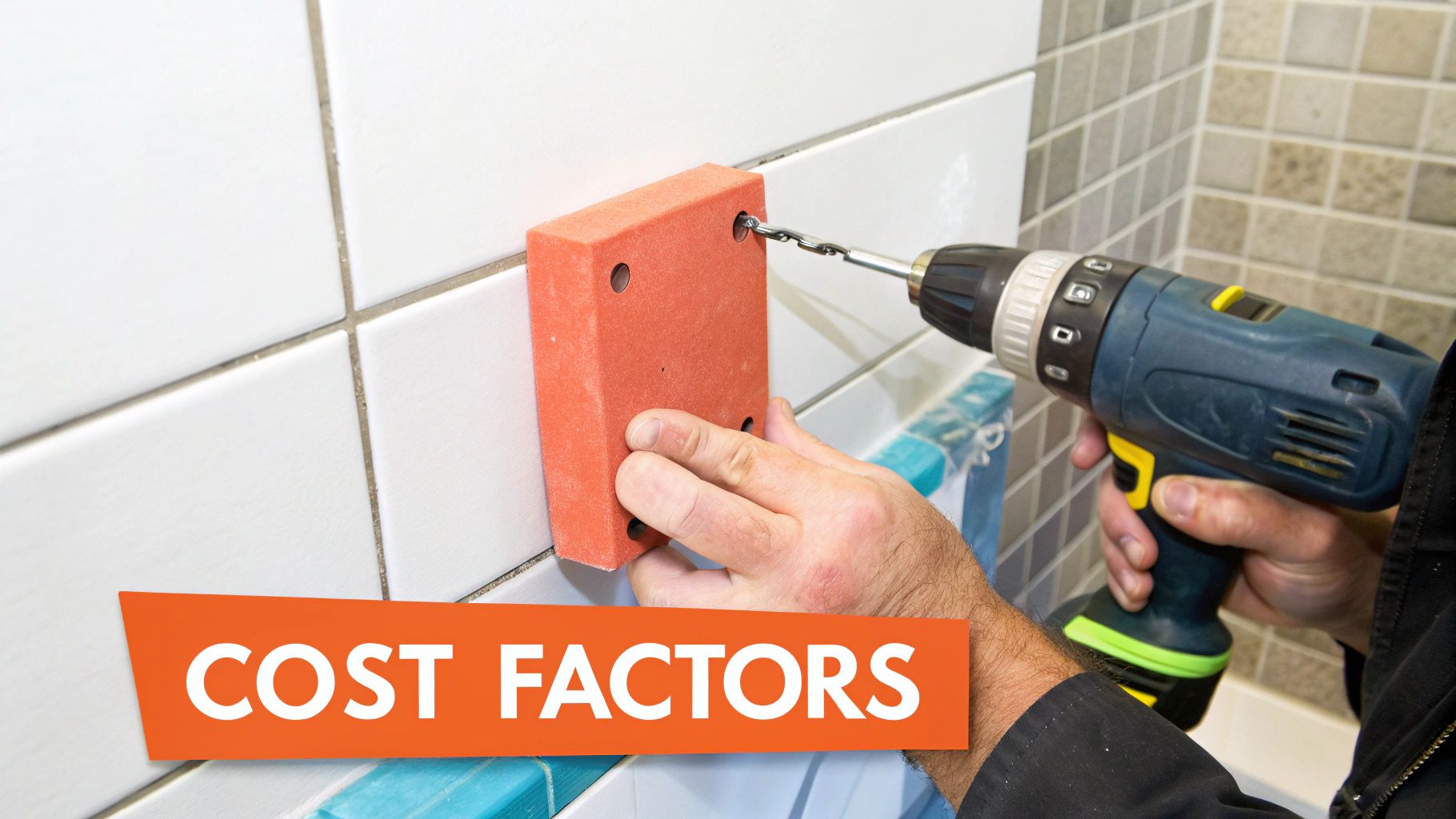
A few key elements can either make the job a breeze or add layers of complexity, directly affecting the time, tools, and money required. Let's break down exactly what those are.
The very first thing an installer looks at is the surface they have to work with. Drilling into standard drywall with easy-to-find wood studs is the most straightforward, and therefore least expensive, scenario. It’s a quick job that requires standard tools.
But the cost starts to climb when you’re dealing with trickier surfaces.
Each of these materials turns a basic task into a specialized one, and the price will reflect that.
What’s inside your wall is just as important as what’s on the outside. A grab bar is only as strong as its anchor point. For maximum support, it absolutely must be mounted directly into solid wood studs. No exceptions.
But what happens if there are no studs right where you need the bar? In that case, the wall needs to be reinforced. This means an installer has to open up the drywall to install solid wood blocking between the existing studs. This creates a rock-solid foundation, but it’s a much more involved process that adds significantly to labor and material costs.
A grab bar installed only into drywall or with flimsy plastic anchors is a critical failure waiting to happen. It creates a false sense of security and simply cannot support a person's weight, especially during a slip or fall.
While your home isn't required to follow the Americans with Disabilities Act (ADA) guidelines, many homeowners choose to. It's a smart move. ADA standards specify precise heights, clearances, and load-bearing capacities—for example, requiring a bar to withstand at least 250 pounds of force.
Achieving this level of safety often means more meticulous work. The installer has to be dead-on with measurements and will likely need to add that wood blocking we just talked about to meet the strength requirements. This extra care ensures the bar provides reliable safety for everyone and is a key part of many home modifications for elderly residents.
The table below shows how these factors can stack up and affect your bottom line.
| Influencing Factor | Cost Impact | Reason |
|---|---|---|
| Drilling into Drywall | Low | Easiest material to work with; standard tools and less time required. |
| Drilling into Tile/Stone | Medium | Requires special diamond-tipped bits and careful technique to prevent cracking. |
| No Studs Available | High | Needs wall to be opened to install wood blocking, adding significant labor and materials. |
| ADA Compliance | Medium-High | Precise measurements and potential for required reinforcement increase labor time. |
As you can see, a simple job can get complicated (and more expensive) pretty quickly depending on what's hiding behind your wall.
Finally, where you live plays a surprisingly large role in the overall grab bar installation cost. Labor rates are not the same across the country. A handyman might charge anywhere from $50 to $125 per hour for this kind of work.
Installers in major metropolitan areas like New York or San Francisco, however, typically charge more to account for a higher cost of living. In fact, labor costs in these urban centers can be roughly 20% above the national average. You can see these regional price differences for yourself over on sites like HomeAdvisor.com.
So, you're looking at that grab bar, then at your toolbox, and thinking, "How hard can it be?" It's a classic crossroads for any homeowner: go the DIY route to save a few bucks, or call in a professional? On the surface, doing it yourself looks like a clear financial win.
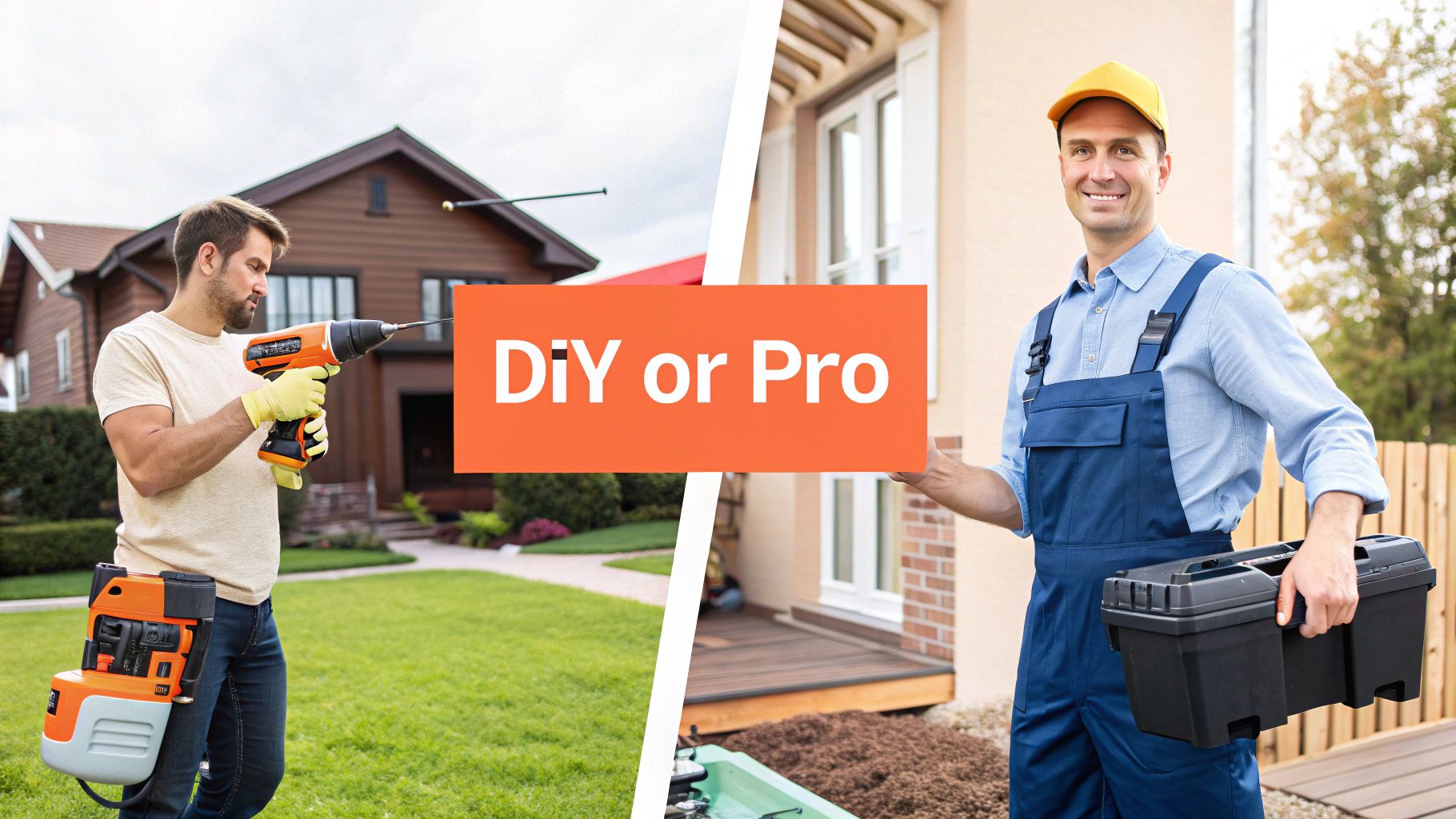
After all, your only costs are the bar itself and maybe a new drill bit. But that simple math leaves out the most critical piece of the puzzle: safety. A grab bar isn't just a bathroom accessory; it's a safety device, plain and simple. Think of it like a seatbelt. It has to work perfectly, without question, the one time you desperately need it.
The single biggest danger with a DIY job is getting the anchoring wrong. A grab bar that isn't bolted directly into solid wood studs is basically just for show. It gives you a false sense of security, and it will fail under the sudden weight of a slip or fall—the very moment it’s supposed to save you.
And the risks don't stop there. Here are a few other ways a simple project can go sideways:
Let’s be clear: a grab bar is not a towel rack. It's a piece of safety equipment that must support a person's full body weight in an emergency. The peace of mind that comes from knowing it’s installed correctly is priceless.
When you hire a pro, you’re not just paying for a drill and an hour of their time. You're investing in their experience, their knowledge of building codes, and their commitment to safety. A professional knows exactly how to find studs, how to handle delicate tile, and how to ensure every screw and seal is 100% secure and watertight.
Seeing this as one of many critical Maintenance Repairs for a home helps put the cost into perspective. It’s not just an add-on; it’s essential upkeep.
Plus, any reputable installer carries liability insurance. This is a huge deal. It protects you and your home from any accidental damage during the installation. Our guide on contractor insurance requirements dives deeper into why this is non-negotiable for anyone working in your home.
So, is there ever a time for DIY? Maybe. If you’re a seasoned home improvement veteran who truly understands wall structures, and you're only installing into simple drywall outside of a wet area, you might be okay. But for any installation inside a shower, through tile, or if you have even the slightest doubt about finding solid wood to anchor into, hiring a professional is the only smart, safe choice.
Making your home safer with properly installed grab bars is a smart move, but it doesn't have to break the bank. You can be strategic about the cost. With a little planning, you can bring the final price down quite a bit without ever compromising on safety. It’s all about working smarter, not cutting corners.
One of the best ways to lower your grab bar installation cost is to bundle multiple jobs into one visit. Just think of it like getting a bulk discount on a professional's time.
Most installers have a minimum service fee that covers their travel and time, whether they're putting in one bar or three. When you have them install several grab bars in a single appointment, you stretch the value of that initial fee. The cost-per-bar often drops, making it much more economical to outfit your entire bathroom at once.
Here’s another great tip: separate the cost of the grab bars from the cost of the labor. You are under no obligation to buy the hardware directly from your installer. This opens up a huge opportunity to find high-quality bars for a much better price.
Keep an eye out for sales at your local home improvement store or from online retailers. By sourcing the grab bars yourself, you can snag some great discounts and then just hire a professional for their installation expertise. This one move can save you a surprising amount on materials alone.
Smart planning is your best tool for managing installation expenses. By preparing your space and purchasing materials wisely, you can make the professional's job more efficient, directly translating into savings for you.
Finally, there’s a simple but often overlooked trick: prepare the work area before the installer arrives. Clear out any clutter from the bathroom, take personal items out of the tub or shower area, and make sure there's a clear path for them to bring in their tools and get to work.
Every minute an installer spends clearing a space is a minute you're paying for. A clean, accessible work area lets them get right down to business, which reduces their time on-site and, as a result, your final labor bill.
These practical steps are all about efficiency.
By combining these tactics, you can make this essential home safety upgrade much more affordable.
Even after a full cost breakdown, it's natural to have a few more questions pop up. Let's tackle some of the most common things homeowners ask about grab bar installation so you can move forward with total confidence.
This is one of the best parts—a straightforward grab bar installation is surprisingly fast. If you've got drywall with standard wood studs, a pro can usually have a single bar mounted securely in about 30 to 60 minutes. It's a quick job that makes a huge impact.
Now, if you're dealing with tougher materials like porcelain tile or marble, things slow down a bit. The installer has to be extra careful to drill without causing any cracks. This kind of detailed work might push the job closer to 90 minutes or even two hours, especially if extra reinforcement behind the wall is needed.
For almost every single residential project, the answer is a simple no. Putting grab bars in your own home is seen as a minor alteration, not a major renovation, so you almost never need to pull a building permit.
This is great news because it means you can skip the hassle of dealing with municipal paperwork and get the job done quickly. That said, any good professional installer will be familiar with local codes, ensuring everything is up to snuff, especially if your grab bars are part of a bigger remodel.
Think of it this way: a grab bar installation is a safety upgrade, not a major structural change. While permits are rarely needed for home installs, the real focus is making sure that bar is anchored so securely it can handle far more than just day-to-day use.
This is a critical point, and the answer is a hard no—at least, not without doing it the right way. A grab bar is only as good as its anchor points. For it to actually save you from a fall, it must be screwed directly into solid wood studs or special blocking installed behind the wall.
Just sticking a grab bar onto drywall with flimsy plastic anchors is a recipe for disaster. It gives a false sense of security and is guaranteed to fail when you need it most. If there isn't a stud exactly where you need the bar, a professional will install wood blocking between the existing studs. This creates a rock-solid mounting surface, and it's a non-negotiable step for a safe installation.
This can be a bit of a mixed bag, so you'll definitely need to check with your specific insurance provider. In most cases, standard health insurance and Medicare Part B won't cover items they classify as "durable medical equipment" for home use, and grab bars often fall into that category.
But don't give up just yet! There are a few other avenues worth looking into:
Your best bet is to pick up the phone and call your insurance provider directly. Ask them specifically about coverage for "home safety modifications" or "aging-in-place equipment" to find out if you can get reimbursed for your grab bar installation cost.
Ready to make your home safer without the guesswork and hassle? Assembly Smart provides professional, reliable grab bar installation with clear, upfront pricing. Our insured technicians know how to handle any wall type, ensuring your grab bars are mounted securely for total peace of mind. Get your free estimate and schedule your appointment today at https://assemblysmart.com.