-
CALL US:
- (866) 952-3456

Finding the right person for your home project can feel like a huge task, but breaking it down into a few key steps makes all the difference. You don't want to just throw a dart at a board. A smart approach combines trusted personal recommendations with a bit of online and local digging. This way, you're building a list of potential pros based on real-world experience, not just slick advertising.
Kicking off a home project, whether it’s a small assembly job or a major renovation, really boils down to one thing: finding a reliable contractor. It’s a process that can feel like a shot in the dark, but with a solid plan, you can turn it from a game of chance into a strategic search. The goal isn’t just to find anybody with a truck and tools; it's to find the right one for what you need, on your budget, and within your timeframe.
The home improvement and construction world is booming, projected to grow from $15.78 trillion to $16.45 trillion in a single year. For homeowners, this means there are more contractors out there than ever before. But it also means you have to be extra careful to sort the true professionals from the rest of the pack.
Your first move should always be to tap into your personal network. Word-of-mouth recommendations from friends, family, and neighbors who’ve had similar work done are pure gold. These referrals come with a built-in layer of trust because you're getting a real, firsthand account of how the contractor actually performs.
When you ask for a referral, dig a little deeper than just, "Were you happy with the work?"
Get specific. Ask questions like:
Answers to these questions paint a much clearer picture of what you can expect if you hire them.
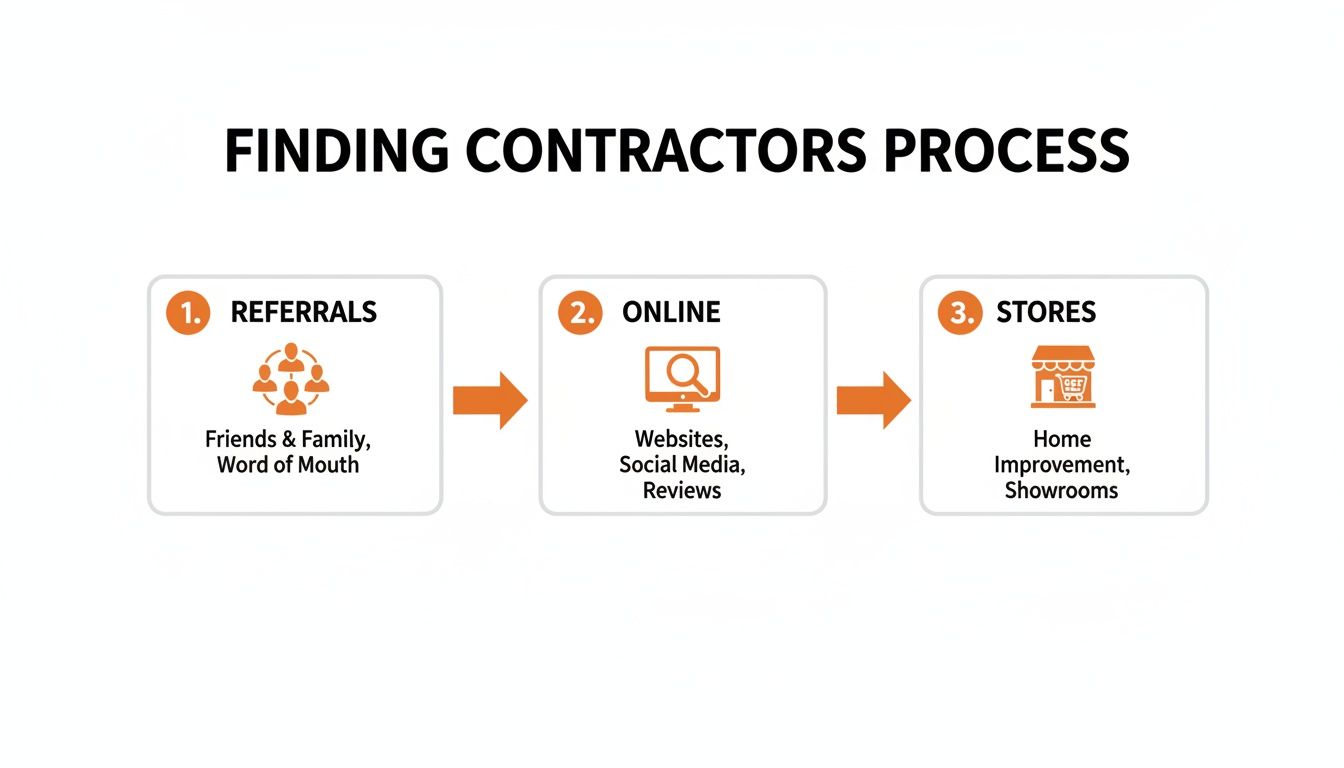
As the graphic shows, a great search blends who you know with the power of online tools and good old-fashioned local intel.
Once you've checked with everyone you know, it’s time to head online. Digital platforms have made finding local contractors easier than ever, but you have to use them smartly. Reputable sites like Angi, Thumbtack, and Houzz are packed with directories, homeowner reviews, and photo galleries of past work.
A word of caution, though: don't take every five-star review at face value. Look for patterns in what people are saying. If you see consistent praise for communication, punctuality, and creative problem-solving, that's a fantastic sign. On the other hand, repeated complaints about missed deadlines or surprise fees are obvious red flags.
Pro Tip: When you're on these sites, try filtering your search for contractors who have been in business for at least a few years and have a good number of recent, detailed reviews. A long track record often points to a stable, reliable business.
Deciding where to look can be tough. Each channel has its own set of advantages and disadvantages, from the high-trust nature of referrals to the sheer volume of options online.
Here's a quick breakdown to help you decide where to focus your energy:
| Search Channel | Pros | Cons |
|---|---|---|
| Personal Referrals | Highly trustworthy, provides firsthand accounts of work quality and professionalism. | Limited pool of options, dependent on your network's recent experiences. |
| Online Directories | Huge selection of contractors, easy to filter and compare, access to many reviews. | Reviews can be fake or biased, top results are often paid ads. |
| Trade Groups (NARI, NAHB) | Members are often vetted and committed to professional standards. | Can be harder to navigate, might not have pros for smaller jobs. |
| Local Supply Stores | Staff have inside knowledge of who is reputable and buys quality materials. | Recommendations are informal and not guaranteed. |
| Social Media/Nextdoor | Quick access to candid, hyperlocal feedback from your actual neighbors. | Advice can be subjective and may lack professional vetting. |
Ultimately, the best strategy is to use a mix of these channels. Start with who you trust, then verify and expand your list with online and local sources.
Believe it or not, some of the absolute best contractors don't pour money into online ads. They're busy because their reputation speaks for itself. Tapping into your local community can help you find these highly skilled pros.
Here are a few places you might not have thought to look:
By pulling from all these different areas, you’ll build a strong, well-rounded list of potential hires. Our more in-depth guide on finding a contractor dives even deeper into these strategies.
Once your list is ready, the next step is to start the crucial process of vetting them.

Alright, you've got a solid shortlist of potential contractors. Now comes the most critical part of the whole process: the deep dive. This is where you move from just finding names to truly vetting them.
Rushing this stage is like buying a car without even checking under the hood—a huge gamble you just can't afford to take with your home. Think of it as a series of essential checkpoints. Each one is designed to protect you, your property, and your wallet from a world of preventable headaches. The goal is to make sure the person you hire is not just good with a hammer, but is also a legitimate, insured, and reliable professional.
First things first, let's talk credentials. Any true pro will be licensed and insured, and they won't hesitate for a second to show you proof. But don't just take their word for it. You need to verify it yourself.
This isn't just red tape; it's your financial shield. If an uninsured worker gets hurt on your property, you could be on the hook for their medical bills. This step is completely non-negotiable.
Next up, you need to talk to people who have already been in your shoes. Getting on the phone with past clients is the single best way to get an unfiltered look at how a contractor really operates—their communication, their quality, and their process. Ask for at least three recent references.
When you call, have a few specific questions ready so you get the full picture.
The answers here are gold. Pay close attention to how they answer. If a past client is gushing with enthusiastic details, that’s a fantastic sign. But if they're hesitant or vague, that might be a red flag. For a full breakdown, our contractor hiring checklist has an exhaustive list of questions to ask.
Personal references are powerful, but online reviews give you a much broader perspective. Check out their profiles on Google, Yelp, and other industry sites. The key is to look past the star rating and actually read what people are saying.
Look for patterns in the comments. Is everyone raving about their communication and craftsmanship? Great. On the other hand, if you see repeated complaints about missed deadlines, ghosting clients, or leaving a mess, you should be concerned.
Before you hire anyone, learning how to choose and vet a professional service is a skill that will serve you well. Recognizing those patterns, both good and bad, is crucial for making a smart decision.
Finally, you need to know who will actually be doing the work. The construction industry is facing some serious labor shortages—one report showed that 88% of contractors have a hard time finding qualified workers. This can directly impact your project's timeline and quality.
Ask some direct questions about their crew.
A contractor with a stable, experienced team is usually a sign of a well-managed business that can actually deliver on its promises. A few simple questions upfront can save you from the nightmare of a project that stalls out because their crew disappeared. Proper vetting isn't about being difficult; it's about being smart and setting your project up for success from the get-go.

Okay, you’ve done the research and narrowed down your list. Now comes the most revealing part of the whole process. This isn't just a simple Q&A session; think of it as a two-way conversation that decides who you're trusting with your home and your money for the next few weeks or months.
This is your chance to get a real feel for a contractor beyond their online profile. You'll get to see their communication style, how they tackle problems, and their general professionalism firsthand. A good interview reveals what a paper trail never can.
When you sit down with a contractor, your real goal is to understand their process, not just their price. Sure, cost is a big deal, but a contractor’s approach to managing the job and dealing with the inevitable surprises is a much better predictor of how the project will actually go.
Move past the basic questions and ask things that make them think. You'll learn a lot from their answers.
These questions shift the focus from what the project costs to how it will get done. You’re looking for a partner, not just a hired hand.
After the interviews, the bids will start rolling in. This is where it can get overwhelming, especially if the prices are all over the map. The absolute key here is to insist on a detailed, itemized bid from every single contractor.
A single lump-sum number is a massive red flag. A professional bid breaks everything down so you can make a true apples-to-apples comparison.
A proper bid should clearly list:
A suspiciously low bid is often more dangerous than a high one. It can signal subpar materials, uninsured labor, or a desperate contractor who plans to make up the difference with expensive change orders later.
In today’s market, material costs and availability can change in a heartbeat. Supply chain issues are a real headache for local contractors, with construction material prices jumping over 2% in the last year alone. A good contractor will have a plan for this. Ask them straight up how they handle it.
You also need to understand where your money is going. If the bid includes hourly labor, it's a good idea to know the going rate in your area. You can learn about the average handyman hourly rate to see if their pricing seems fair for smaller jobs that might pop up.
A real pro has solid relationships with local suppliers and backup plans ready. Talking about this upfront can prevent your project from grinding to a halt for weeks because a specific type of tile is back-ordered.
Once you have the itemized bids, throw them into a simple spreadsheet to compare them side-by-side. Don't just stare at the total at the bottom. Look closely at the quality of materials they're proposing, their experience level, and how clear their communication has been.
Consider the whole package. The contractor who came in a little higher but communicated clearly and had a solid plan for potential hiccups might be the much better value in the long run. Beyond just comparing line items, knowing how to talk terms is a crucial skill. Learning to negotiate with contractors like a pro can save you money and headaches.
At the end of the day, trust your gut. The interviews and detailed bids should give you a pretty clear picture of who is the most organized, transparent, and capable. Choosing the right person is about finding the best overall value, not just the cheapest price.
Okay, you've done the hard work of finding and interviewing contractors. Now comes the single most important document in the entire project: the contract.
Think of it this way: a vague agreement is a one-way ticket to problems. A detailed, well-written contract, on the other hand, is your best defense against surprise costs, frustrating delays, and shoddy work. It’s not just a formality—it’s the legal playbook that keeps everyone honest and on the same page.
A professional, trustworthy contractor will provide a thorough contract that leaves absolutely nothing to chance. Before you even think about putting pen to paper, give the document a once-over for these non-negotiable elements. If you don't see them, it's a huge red flag.
Here’s what your agreement must clearly spell out:
A well-structured contract protects everyone. It’s your guarantee that you get exactly what you paid for, and it ensures the contractor gets paid for the work they complete as agreed.
The fine print matters, too. For instance, understanding the specific contractor insurance requirements and making sure proof of that coverage is included in your contract is a critical step in protecting your home and finances.
It’s always a good idea to have a checklist handy when reviewing the document.
A proper contract turns spoken promises into legally binding commitments. Here’s a quick-glance table to help you verify that all the critical pieces are in place before you sign.
| Contract Component | What to Look For | Why It's Critical |
|---|---|---|
| Scope of Work | Hyper-detailed list of all tasks, materials, and model numbers. | Prevents "I thought that was included" arguments and scope creep. |
| Total Cost | A firm, final price with an itemized breakdown of expenses. | Provides total transparency and helps you understand where your money is going. |
| Payment Schedule | Milestone-based payments tied to project completion (e.g., framing done). | Ensures your payments never get ahead of the actual work being performed. |
| Timeline | Clear start date, estimated completion date, and key milestones. | Holds the contractor accountable for finishing the job in a timely manner. |
| Change Order Process | A written procedure requiring your signature for any new work. | Protects you from surprise charges and unauthorized changes to the project. |
| Insurance & Licenses | Proof of general liability and worker's compensation insurance. | Protects you financially if an accident happens or property is damaged. |
| Warranties | Specifics on workmanship warranty (at least 1 year) and material warranties. | Guarantees the quality of the work and materials long after the final check clears. |
| Lien Waivers | A clause requiring lien waivers from subcontractors and suppliers. | Protects your property from liens if your contractor fails to pay their bills. |
| Dispute Resolution | A clear process (e.g., mediation) for handling disagreements. | Provides a structured, less costly way to resolve conflicts if they arise. |
Having every one of these elements clearly defined in your contract gives you the security and peace of mind to move forward with your project confidently.
One of the biggest mistakes I see homeowners make is paying too much money upfront. A massive deposit gives you very little leverage if the contractor’s work is subpar or, even worse, they disappear completely.
The industry standard is to tie payments directly to completed work. This milestone-based approach keeps both you and the contractor motivated and accountable. It's the best tool you have for managing risk.
Here’s what a fair payment structure often looks like:
This system guarantees that your payments never get ahead of the work actually completed on your home.
So, you've signed on the dotted line and have a start date circled on the calendar. Great! Your job now shifts from being a talent scout to being the project manager.
Don't worry, this doesn't mean you need to trade your coffee mug for a hard hat. It’s more about staying in the loop and guiding the project toward the finish line—without getting in the way of the professionals you hired to do the work. It's a delicate balance, but getting it right ensures the vision you agreed on becomes a reality, down to the very last detail.
Before anyone even thinks about swinging a hammer, there's paperwork to handle. A lot of home improvement jobs, whether it's building a new deck or just moving an interior wall, will require a building permit from your city or county. This isn't just red tape; a permit ensures all the work is up to code, which is critical for your family's safety and your home's value down the road.
So who's in charge of getting this permit? The contractor. Any reputable pro will take care of the entire permitting process, from submitting the plans to scheduling the necessary inspections with the city. If a contractor ever asks you to pull the permit yourself, see it as a massive red flag. That move can shift all the legal liability for the work squarely onto your shoulders.
Safety on the job site is just as important. Your contractor should be taking the lead on this, and you should expect them to:
This protects their crew, but it also protects your family and your property from accidents. Don't hesitate to ask them about their safety and cleanup routines.
Clear and consistent communication is the secret sauce for a smooth project. Most headaches and frustrations on a job come from a simple lack of information. The best way to prevent this is to set up a communication plan with your contractor from day one.
Agree on a regular check-in schedule. Maybe it’s a quick 10-minute chat every morning before they start, or perhaps a detailed email update every Friday works better. This simple rhythm keeps you informed, gives you a chance to ask questions, and helps nip small issues in the bud before they blow up into major problems.
A great project manager knows that constant communication is what prevents misunderstandings. The goal is to create a "no surprises" environment where you can openly talk about progress and potential roadblocks.
This approach lets you oversee things without having to micromanage. You're showing you trust them to do the work, and in return, they see you as an engaged, reasonable partner.
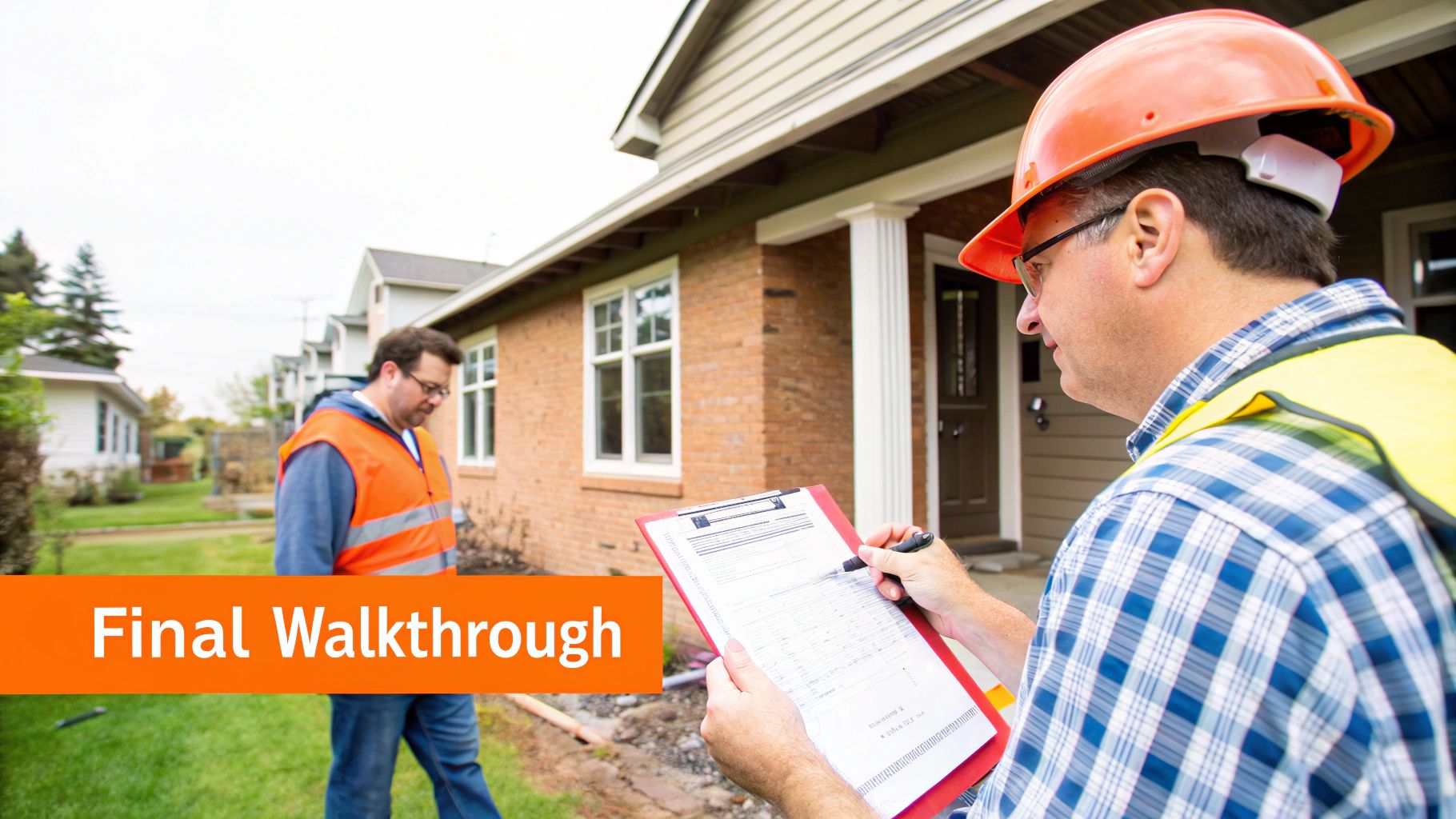
As the dust settles and the project winds down, you get to the most satisfying part: the final walkthrough. This is your official chance to walk through the finished space with your contractor and inspect every inch of the work. The goal here is to create a punch list—a simple, written list of any final tweaks or fixes that are needed.
Take your time and be meticulous. Flip every light switch, test every faucet, open and close all the new doors and cabinets. Look closely at the paint finish, the tile grout, and the trim work. A good contractor won't rush you; they'll expect this level of scrutiny because they want you to be 100% satisfied with the job.
Once you’ve built the punch list together, agree on a reasonable deadline for them to complete those last items. Hold onto that final payment until every single thing on that list has been checked off. It’s a simple step, but it’s the one that guarantees your project ends on a high note, with the quality you paid for.
Even the most buttoned-up project plan can hit a snag when it comes to hiring a contractor. You’re bound to have questions, and getting straight answers is the only way to feel good about who you’re letting into your home. Let's walk through some of the most common things homeowners get stuck on.
First off, let's clear up the lingo. What’s the real difference between an estimate, a quote, and a bid? Think of an estimate as a ballpark figure—a rough guess that’s good for initial budgeting but isn’t set in stone. A quote, on the other hand, is a more formal, fixed price for a very specific job. A bid is similar but usually means the contractor is competing against others for your project. For anything serious, you absolutely want a detailed quote or bid, not just a casual estimate jotted on a napkin.
There’s no magic number here, but from my experience, the sweet spot is three bids. This gives you enough perspective to make a smart comparison without sending you into a spiral of "what ifs."
With fewer than three, you really have no idea what the going market rate is or what different approaches might look like. If you start collecting more than five, you’re just going to get overwhelmed. Three solid, itemized bids from properly vetted contractors will give you a crystal-clear picture of what your project should cost and who’s the right fit for the job.
Disagreements can pop up on even the smoothest projects. If you and your contractor hit a bump in the road, the very first thing you should do is pull out that signed contract. A detailed agreement is your best friend for sorting out disputes over the scope of work, costs, or quality.
Learning to spot the warning signs early can save you from a world of hurt. As you find local contractors, keep a sharp eye out for anyone who:
At the end of the day, trust your gut. If a contractor’s communication just feels off or they’re dodging your questions, it’s probably a sign of bigger problems. The goal isn’t just to find the cheapest person, but to find a professional partner you can actually trust in your home. Taking your time to make a careful, informed decision is the best investment you can make.
For those smaller jobs, like putting together new furniture or installing equipment, you don’t need to go through the whole general contractor process. Assembly Smart is the simple, stress-free alternative. We have professional, insured technicians ready to get the job done right. Get your free estimate and you can even book a next-day appointment.