-
CALL US:
- (866) 952-3456

Think of ready to assemble furniture brands as the brilliant minds behind a high-quality model kit, but for your home. These companies design stylish pieces that arrive neatly packed in a flat box, complete with every part and instruction you need to build them yourself. It's a clever system that delivers trendy designs at a fraction of the price you’d pay for something pre-assembled.
Ready to assemble (RTA) furniture, which you've probably also heard called flat-pack, is a system built entirely around efficiency. Brands in this space have truly mastered the art of breaking down complex items—like dressers, beds, and office desks—into a neat collection of manageable components. By shipping these pieces disassembled, they slash their freight and warehousing costs.
And here’s the best part: those significant savings get passed directly on to you. This is what makes stylish, modern furniture accessible to just about everyone, from first-time apartment renters to families trying to furnish a new home without breaking the bank.
The big idea is simple but powerful. Instead of selling you a huge, pre-built bookcase that needs a delivery truck and a team of movers, RTA brands sell you the potential of a bookcase. They give you the blueprint and all the raw materials, empowering you to handle the final step yourself.
This entire business model really leans on a few key things:
The real genius of the RTA model is how it democratized good design. It separates the look and feel of the furniture from the high costs of old-school manufacturing and logistics, putting beautiful pieces within almost everyone's reach.
While the lower price is what gets most people's attention, the rise of ready to assemble furniture brands is about more than just a good deal. It's a shift toward giving customers more flexibility and control. For a deeper dive into the mechanics and history, you can learn more about what flat-pack furniture is and how it completely changed the industry.
Ultimately, these brands offer a practical solution for the way we live now. They're perfect for people who move more often, live in apartments where getting a giant sofa up the stairs is impossible, and even for those of us who just enjoy the satisfaction of building something with our own two hands. This guide will help you navigate this world, from spotting quality brands to making sure your assembly day goes off without a hitch.
Diving into the world of ready to assemble furniture brands can feel a bit like exploring a new city. You’ve got different neighborhoods, each with its own vibe, price point, and overall quality. Not all flat-pack furniture is the same, and knowing the lay of the land is the key to finding exactly what you need for your home and your wallet.
It’s a lot like buying a car. You have your super-reliable, budget-friendly models that get you from point A to point B, no frills attached. Then you have the comfortable mid-range options with more features and a smoother ride. And, of course, there are the luxury cars built for high performance and premium comfort. The RTA furniture market is broken down in a very similar way.
At its core, the RTA model is beautifully simple: a brand designs a stylish piece, figures out how to pack it flat, and then you, the customer, complete the final step of assembly at home.
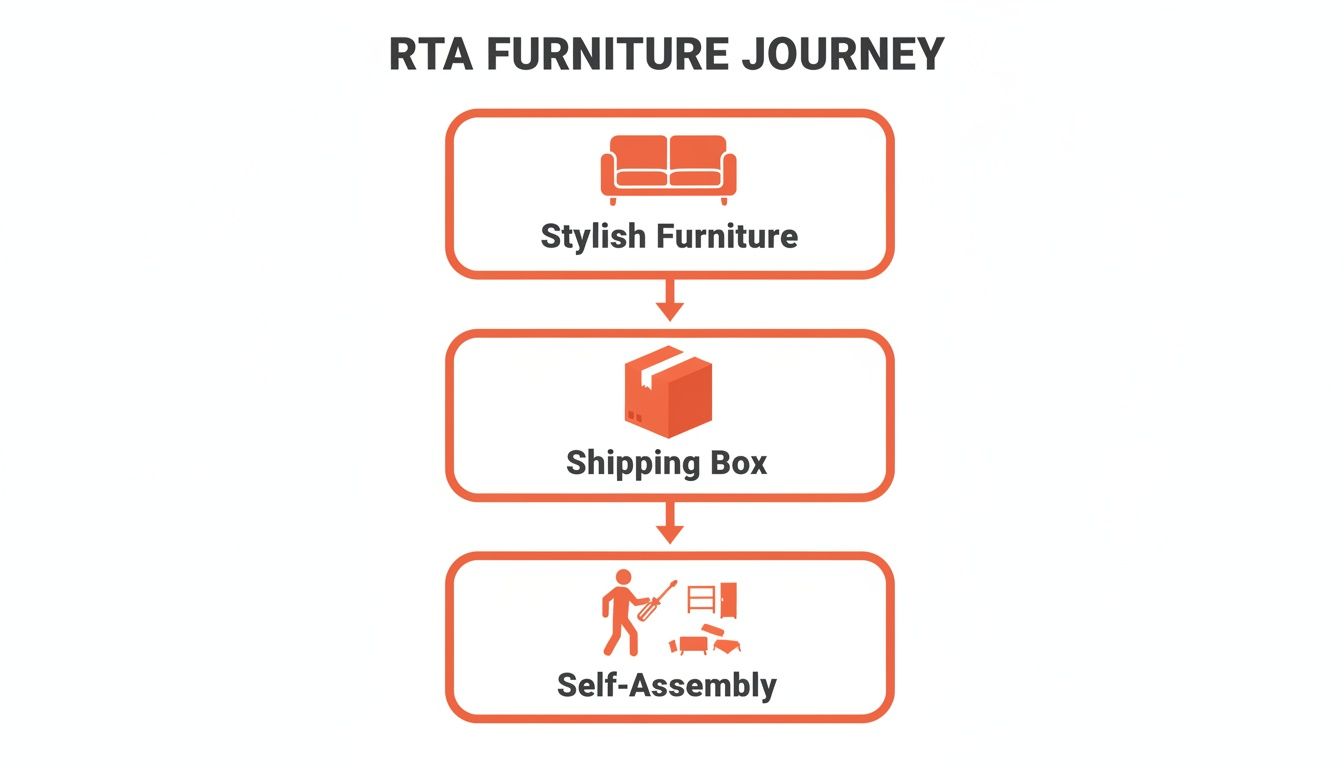
This process is what makes it all possible, allowing for stylish designs to be shipped efficiently right to your door. Let's break down the "neighborhoods" you'll find.
To make sense of it all, let's compare the three main tiers side-by-side. Each one serves a different purpose, so the "best" choice really depends on your priorities—whether that's budget, ease of assembly, or long-term durability.
| Attribute | Budget Mass-Market | Mid-Range D2C | Premium Modular |
|---|---|---|---|
| Price | Low ($ – $$) | Moderate ($$ – $$$) | High ($$$ – $$$$) |
| Materials | Particleboard, MDF, Laminates | Plywood, Engineered Wood, Solid Wood Accents | Solid Hardwoods, Premium Metals, High-End Finishes |
| Assembly | Often complex, many small parts, pictorial instructions | Simplified, often tool-free or minimal tools | Can be complex due to precision and customization |
| Longevity | Short to medium-term, best for low-traffic use | Medium to long-term, built for daily life | Investment grade, designed to last decades |
| Ideal For | Renters, students, first-time buyers, trendy updates | Homeowners, those upgrading from budget furniture | Discerning buyers seeking custom, long-term solutions |
| Examples | IKEA, Sauder, Wayfair Basics | Burrow, Article, Thuma | Floyd, Tylko, USM Haller |
Seeing it laid out like this really clarifies the trade-offs. You're not just choosing a piece of furniture; you're choosing a balance of cost, quality, and convenience that fits your life right now.
This is the tier most people are familiar with, home to giants like IKEA and Sauder. These brands have mastered the art of making trendy designs affordable for just about everyone. Their secret? Volume. They produce massive quantities using cost-effective materials like particleboard and MDF with laminate or veneer finishes to keep the price tag down.
The main draw here is getting a stylish look for less. You can furnish an entire apartment on a tight budget, which is a lifesaver. The trade-off is that assembly can be more of a project, often involving a dizzying number of small parts and picture-only instructions that demand your full attention. While these pieces aren't family heirlooms, they offer incredible value for renters, students, and anyone needing a quick, stylish fix. They're also fantastic for finding the best furniture for small spaces, thanks to their smart, compact designs.
Climb one step up the ladder and you'll find a wave of exciting direct-to-consumer (D2C) brands like Burrow, Article, and Thuma. By selling primarily online, they slice out the retail middleman, which allows them to offer much higher quality for a very competitive price.
So, what makes them different?
These brands hit the sweet spot for a lot of people. You get a serious upgrade in quality and durability without venturing into true luxury territory. It's the "smart upgrade"—you're investing a bit more upfront for furniture that will look better, feel sturdier, and last much longer.
At the very top of the RTA world, you'll find premium brands that focus on customization, high-end materials, and impeccable craftsmanship. We're talking sophisticated closet systems, designer office setups, and modular living room furniture that stands shoulder-to-shoulder with fully assembled luxury pieces.
Here, the game is all about investment-grade quality. You'll see solid hardwoods, premium metals, and innovative engineering that makes everything fit together perfectly. The assembly can be complex because of the precision involved, but the payoff is an exceptionally stable and durable piece of furniture tailored exactly to your space. The price is significantly higher, but for that, you get bespoke quality with the shipping convenience of flat-pack.
Choosing from the endless list of ready to assemble furniture brands means looking past the polished product photos. To avoid that sinking feeling of buyer's remorse, you need a pre-purchase checklist. It's time to become a detective and investigate everything from the raw materials to what other customers are saying about their assembly experience.
A beautiful design is only half the story. The other half involves materials that can handle daily life, hardware that holds everything together securely, and a company that actually stands behind its products. Taking just a few extra minutes to check these details can save you hours of frustration later on.
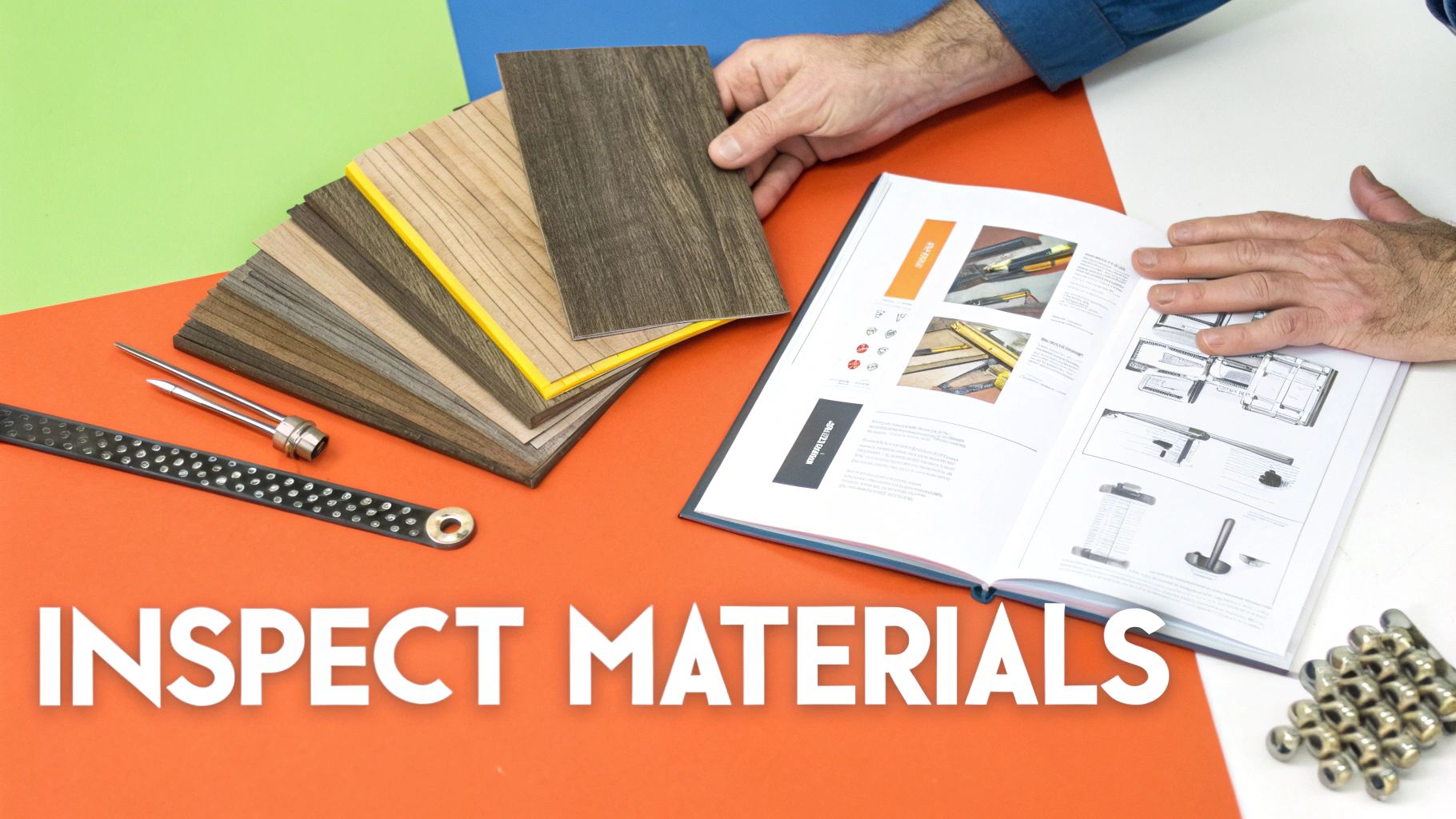
The foundation of any good piece of furniture is what it’s made from. In the RTA world, you'll mostly run into three types of wood-based materials, each with its own trade-offs when it comes to durability and cost.
Just as critical is the hardware—all those nuts, bolts, screws, and cam locks are the skeleton holding your furniture together. Flimsy metal bits are a recipe for wobbly tables and sagging shelves. Keep an eye out for brands that use substantial, corrosion-resistant metal hardware; it's a huge clue about the overall quality.
Real customer reviews are your secret weapon. But don't just glance at the star rating; dig into what people are specifically saying about the assembly process. A five-star review for a beautiful desk isn't much help if the person who wrote it had to hire an engineer to figure out the instructions.
Look for patterns in the feedback. Are lots of people complaining about missing parts, misaligned holes, or diagrams that look like abstract art? These are massive red flags pointing to poor quality control.
A brand's commitment to you, the customer, is often revealed in its instruction manual. Before you buy, try searching online for the product's assembly manual. If it’s clear, detailed, and easy to find, that’s a great sign the company wants you to have a smooth, frustration-free build.
A company’s warranty and return policy tell you a lot about how much confidence they have in their own stuff. A limited one-year warranty is pretty standard for budget brands. On the other hand, premium companies might offer five years or even a lifetime guarantee on certain parts.
Before you click that "buy" button, make sure you understand the return process completely. Who pays for return shipping if the item shows up damaged or just doesn't fit? Flat-pack boxes can be shockingly heavy and expensive to ship back, turning what should be a simple return into a costly headache.
And please, measure your space first! Our guide on how to measure furniture has simple steps to avoid this all-too-common mistake. Taking a few moments to check these policies can save you from a major hassle down the line.
That feeling when the delivery truck pulls away and you're left with a brand-new box from one of your favorite ready to assemble furniture brands is fantastic. The potential is right there. But let's be honest, that excitement can quickly sour once the box is open and you're staring at a mountain of parts and a cryptic instruction manual.
A successful build isn’t about luck—it’s about preparation. Think of it like a chef preparing their mise en place. They don't start cooking until every ingredient is chopped, measured, and ready to go.
Adopting that same mindset can turn a potentially hair-pulling experience into a smooth, manageable project. If you slow down, get organized, and take a good look at what you’re getting into, you'll protect your investment, your time, and your sanity. The end result? A finished piece that looks just as good in your living room as it did on the website.
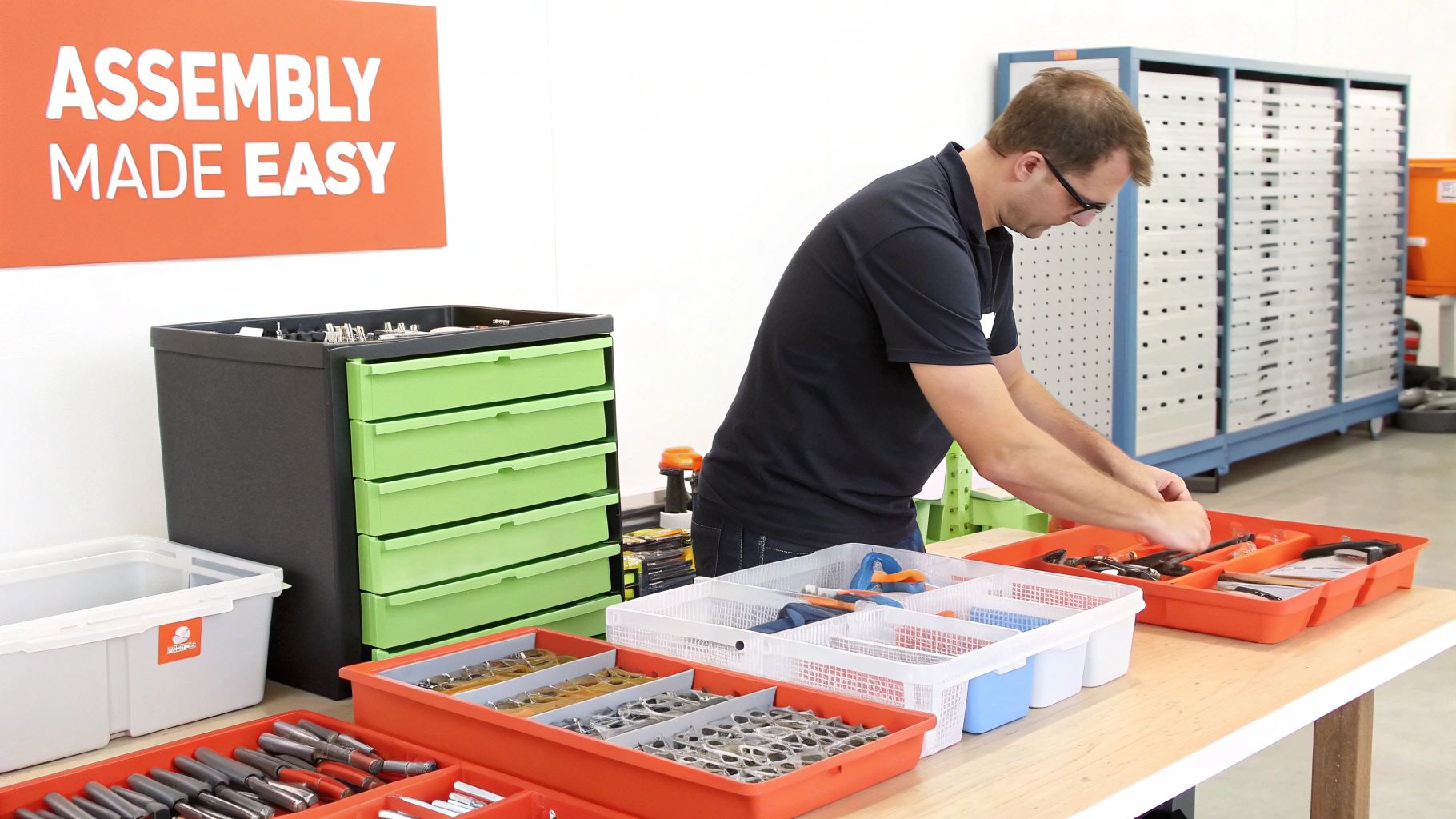
Before you even slice the tape on that box, pick your spot. You need a clear, well-lit workspace, and trust me, you'll need way more room than you think. You have to account for the furniture's final footprint plus space to lay out every single panel, leg, and bag of hardware. A great pro tip is to lay down a blanket or the flattened cardboard box to protect both your new furniture and your floors from scratches.
Next up, inventory. Take a few minutes to carefully check every part and piece of hardware against the list in the manual. Discovering a missing cam lock now is an inconvenience; discovering it when you’re halfway through the build is a disaster. To stay organized, try sorting screws and dowels into small bowls or even a muffin tin.
Finally, round up your tools. Sure, most kits come with a tiny Allen key, but you'll have a much better time with some real tools. A good Phillips head screwdriver, a rubber mallet, and sometimes a power drill with a torque-limiting clutch can be absolute game-changers. For a full rundown, check out our guide on the must-have furniture assembly tools.
Now it's time for a reality check. Putting together a simple end table is a fun little evening project. Assembling a massive, floor-to-ceiling wardrobe with drawers and integrated lighting? That's a whole weekend commitment.
Be on the lookout for these signs that you've got a complex build on your hands:
If you're looking to build your confidence for these bigger jobs, tackling other DIY furniture projects can be a great way to hone your skills.
Knowing when to call for backup is a smart move, not a sign of failure. If the instructions are confusing, you're short on time, or the piece is simply too large and heavy to manage alone, bringing in a professional is the best way to guarantee a perfect, stress-free result.
Hiring a professional service like Assembly Smart ensures your new furniture is built correctly, securely, and without you having to lift a finger. Think of it as a small investment to protect a much larger one, freeing you up to just enjoy your new piece without any of the assembly headaches.
If you've found yourself shopping for flat-pack furniture lately, you're not alone. It’s part of a huge shift in how we're all furnishing our homes. The explosion in popularity of ready to assemble furniture brands isn't just about saving a few bucks anymore. It’s a direct answer to some big changes in the way we live, work, and shop for the stuff that makes a house a home.
Just think about how our living spaces have changed. More and more of us are living in cities, which often means cozier apartments and smaller homes. Trying to wrestle a massive, pre-built armoire up a narrow flight of stairs is a nightmare. RTA designs, on the other hand, are built for this reality. They make it possible to get stylish furniture into tight spaces and maximize every single square foot.
The way we use our homes has been completely turned on its head, too. The massive shift to remote and hybrid work basically forced millions of us to carve out a home office from a spare bedroom, a corner of the living room, or even a closet. This created a sudden, massive demand for functional, affordable office furniture—a category where RTA brands absolutely shine.
Practically overnight, people needed a real desk and a decent chair, and they needed them fast without breaking the bank. Ready to assemble furniture was the perfect solution, giving people a way to set up a productive workspace without a huge investment.
The growth of the RTA furniture market is a clear reflection of modern life. It’s a direct answer to smaller living spaces, the necessity of a home office, and a collective desire for stylish, budget-friendly options that don’t compromise on design.
On top of all this, you've got a major generational shift. Younger buyers, who are often working with tighter budgets, are naturally drawn to the value RTA furniture offers. They're way more comfortable with the DIY angle, seeing it as a smart way to get a high-end look for a lot less money.
These forces—city living, working from home, and being more cost-conscious—are what’s really pushing the industry forward. It’s not just a hunch; market analysts point to these exact trends when they forecast strong growth for the sector, with many expecting sales to climb by 4-7% every year through 2030. You can explore the data behind these market trends to see the bigger picture.
Of course, this boom has highlighted one very important thing. While the furniture itself is easier to get, putting it together is still a major roadblock for a lot of people. This is where professional assembly services have become an essential part of the puzzle. An expert assembler bridges that gap between a box of parts and a perfectly finished piece of furniture, making sure the vision you bought online becomes a sturdy, beautiful reality in your home—without any of the stress.
So there you have it. You're no longer walking into the world of RTA furniture blind. Now that you know the difference between the quality tiers, what to look for before you click "buy," and how to size up an assembly project, you can find some incredible pieces for your home that don't break the bank.
The whole point is to actually enjoy your new furniture, not spend a weekend cursing at it. Every choice you make—from the materials to the brand—gets you one step closer to turning an empty corner into a space that feels like you. The best piece of furniture is always the one that fits your budget, your life, and, frankly, your patience for a weekend project.
There’s nothing quite like the feeling of stepping back and admiring a piece of furniture you built yourself. It's more than just a new bookshelf; it’s proof of your own hard work and smart planning. You’ve figured out how to spot decent quality, clear a workspace, and honestly assess when a build is a fun challenge versus a one-way ticket to frustration.
And if you want to take it a step further? You can always add your own personal touch. For some great ideas on customizing your new RTA piece or just sprucing up an old one, check out this guide on using sticky back plastic for furniture flawlessly.
The real win isn't just getting affordable, stylish furniture—it's achieving your desired outcome without the stress, hassle, or second-guessing. A perfectly assembled piece of furniture is the final, crucial step in that process.
Whether you're a busy professional who values their time or a DIYer staring down a ridiculously complex wardrobe system, sometimes calling in a pro is the smartest move you can make. It isn't about giving up; it's about choosing a guaranteed perfect result.
Our teams live and breathe this stuff. They make sure every piece is built correctly, safely, and exactly the way the manufacturer intended. We handle the confusing instructions and the hunt for that one missing screw so you don't have to. All you need to do is get back to what matters—enjoying your beautifully furnished space.
When you're ready to skip the hassle and go straight to the finish line, Assembly Smart is here to help. Get your free estimate today and let our pros do the heavy lifting for you.