-
CALL US:
- (866) 952-3456

The right home fitness equipment is a deeply personal choice, not something you can just pick off a shelf. The perfect setup for you is one that lines up perfectly with your fitness goals, the actual space you have to work with, and of course, your budget. This guide will walk you through how to nail that decision.
Diving into the world of home fitness gear can feel overwhelming. You're hit with everything from high-tech "smart" treadmills to a simple set of resistance bands. It's no wonder so many people get paralyzed by choice and end up buying something that becomes a very expensive laundry rack.
The secret isn't finding the one single "best" machine out there. It's about finding the right tools that actually fit into your life.
The whole process gets a lot easier when you break it down into three simple questions. Think of these as the foundation for your entire home gym plan. Getting these right from the start means every dollar you spend and every square foot you use is a smart investment in your health.
Before you even start browsing, you need a clear picture of what you want to accomplish. Are you trying to boost your heart health? Build serious muscle? Or maybe you just want to improve your flexibility and move better? Your "why" is the single most important factor.
If you want a deeper look at these core pieces, we've put together a guide on home gym equipment essentials that breaks it all down.
Next, it's time for a reality check on your space and finances. A massive power rack might be your dream, but not if it completely takes over your living room. That premium smart gym looks amazing in the ads, but only if it doesn't blow up your budget.
The best home gym is the one that fits into your daily life without adding more stress. Your equipment should empower you, not become a logistical or financial headache.
The demand for convenient, at-home workout solutions is exploding. The global home fitness market is projected to jump from USD 12.26 billion in 2024 to nearly USD 19.79 billion by 2032. What does that mean for you? More options at every price point than ever before, making it much easier to find great gear that fits both your space and your wallet.
This simple flowchart shows how your goals, space, and budget all work together to point you toward the right kind of equipment.
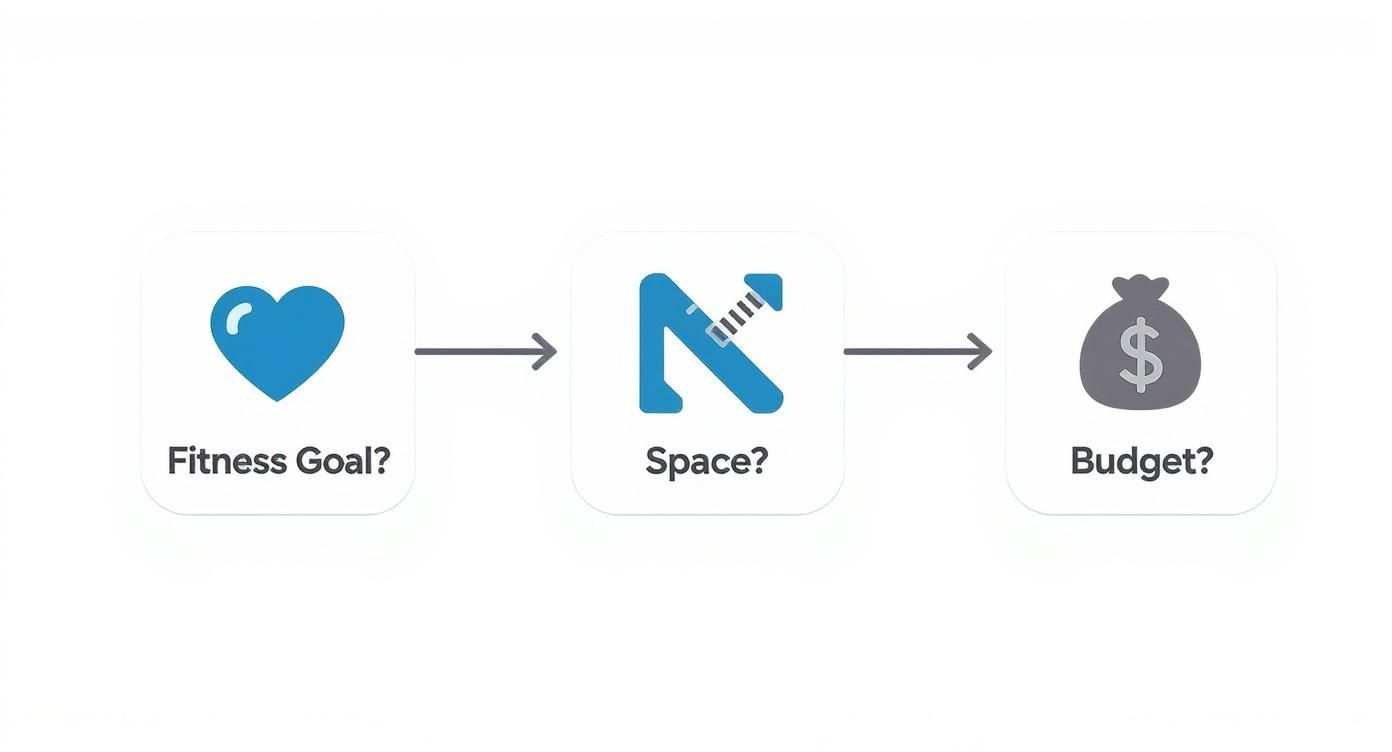
By following this flow, you can cut through the noise and narrow down dozens of possibilities to just a handful of choices that are perfect for you.
Cardiovascular exercise is the cornerstone of a healthy life, and bringing that power into your own home is a game-changer. But choosing the right machine isn’t just about the latest tech or the fanciest features. It's about finding a rhythm and movement you genuinely enjoy—something that won't end up as a glorified coat rack.
Think of each machine as a different road to the same destination: better heart health. The trick is to match the machine's style to your body's needs and what you actually like to do. Let's dig into the most popular options to find the one that will become a go-to part of your routine.
It's clear people are catching on to the convenience of working out at home. The global market for at-home fitness equipment is set to explode from USD 9.34 billion in 2024 to a staggering USD 20.56 billion by 2034. That boom means more innovation and better options are hitting the market all the time.
When you think of a home cardio workout, the treadmill is probably the first thing that comes to mind. It's popular for a reason. It perfectly simulates one of our most basic movements—walking and running—making it incredibly intuitive for almost anyone.
The real beauty of a treadmill is the control it gives you. You can dial in your exact speed, distance, and, most importantly, incline. Cranking up that incline is a secret weapon; it torches calories and fires up your glutes and hamstrings without forcing you to run faster. That versatility makes it perfect for anything from a leisurely walk to all-out sprints.
Stationary bikes are the unsung heroes for anyone needing a fantastic cardio session without beating up their joints. They're a brilliant choice for people with knee or hip issues, anyone coming back from an injury, or those looking for a sustainable workout they can do for years.
Bikes are also incredibly efficient at getting your heart rate up. You can settle in for a steady-state ride or get up out of the saddle to attack a simulated hill climb, which also brings your core and upper body into the mix. Plus, since you're seated, it’s easy to multitask—catch up on a show or read a book during a recovery ride.
Think of a stationary bike as your personal cycling studio. It’s a quiet, smooth, and joint-friendly machine that allows for both relaxing recovery rides and intense, sweat-dripping sprints without ever leaving your living room.
We've put together a detailed breakdown to help you navigate the different types. Check out our guide on the best exercise bikes for home use to learn more about upright, recumbent, and spin-style options.
An elliptical offers a unique workout that feels like a blend of running and stair-climbing, but with zero jarring impact. Your feet stay planted on the pedals, creating a smooth, gliding motion that's incredibly kind to your knees, hips, and back.
What really sets the elliptical apart is its full-body engagement. The moving handlebars work your chest, back, shoulders, and arms at the same time as your legs. This synchronized movement means you can burn more calories in less time compared to other cardio machines. It's the ultimate tool for maximizing workout efficiency while protecting your joints.
The rowing machine is often overlooked, but it's arguably one of the most effective pieces of fitness equipment you can own. It delivers a true full-body workout that hits both cardio and strength, engaging over 85% of your body's muscles with every single stroke.
The movement is a powerful, coordinated chain reaction: your legs drive, your core stabilizes and transfers that power, and your arms and back finish the pull. This makes it insanely efficient for building both endurance and real-world, functional strength.
While cardio machines build your engine, strength equipment builds the chassis. Thankfully, creating a powerful, resilient body at home has never been more straightforward. You don't need a sprawling commercial gym to build muscle, improve bone density, and fire up your metabolism when so many smart, space-saving designs deliver serious results.
The key is to pick versatile tools that can grow with you. Much of the best fitness equipment for home strength workouts is engineered to replace multiple machines, giving you incredible variety without eating up your living room. This focus on multi-functional gear is a huge reason the home gym equipment market just keeps climbing.
In fact, this market is projected to grow from USD 12.4 billion in 2025 to a whopping USD 19.6 billion by 2035. This trend makes one thing crystal clear: people want equipment that's both highly effective and a perfect fit for modern homes. You can dig into the full report on home gym equipment market trends if you want to see all the details.
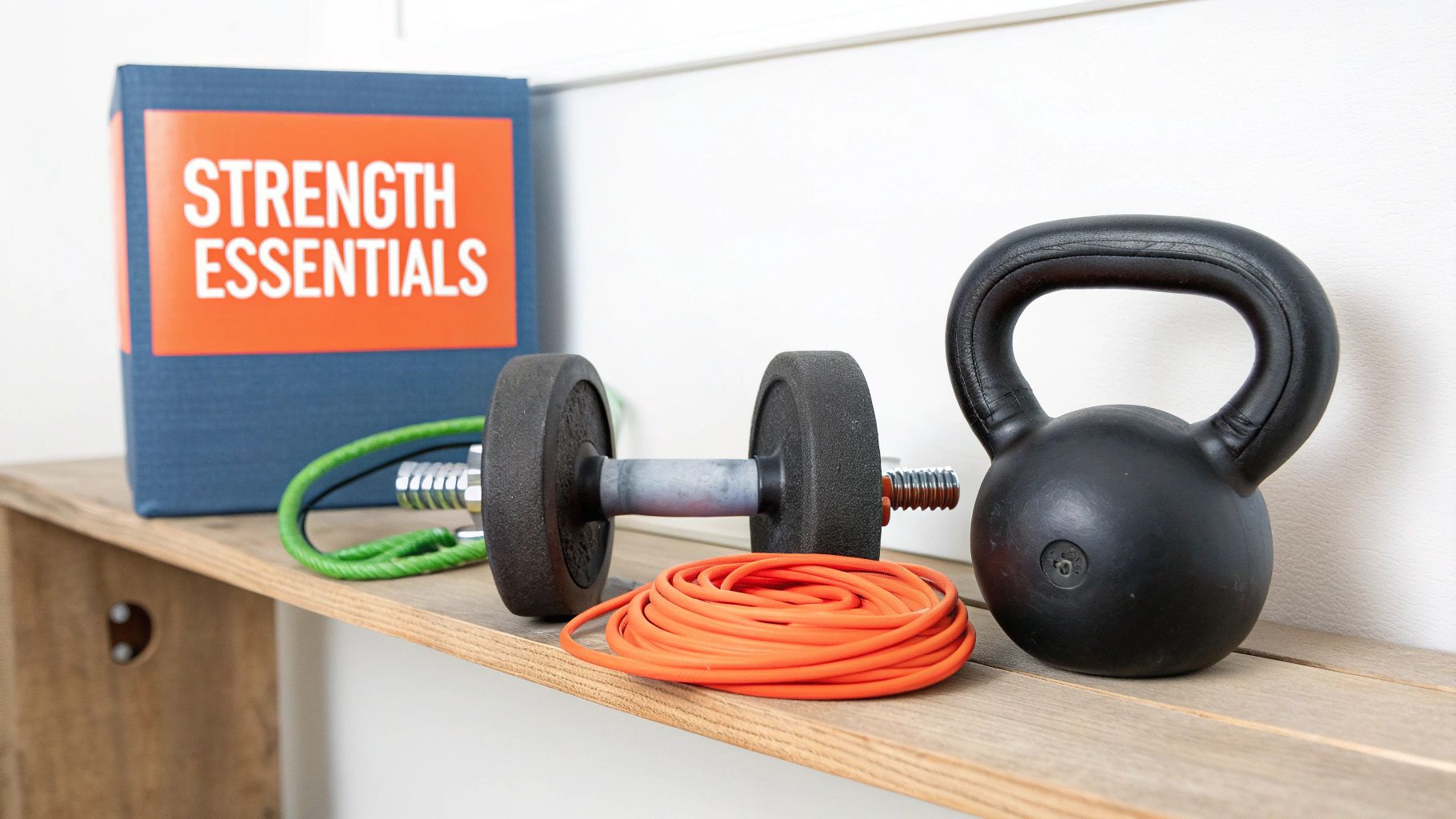
Imagine an entire rack of dumbbells—from light 5-pounders for toning to heavy 50-pounders for serious lifting—all packed into a single, sleek pair. That’s the magic of adjustable dumbbells. They are, without a doubt, one of the most efficient investments you can possibly make for a home gym.
With a quick turn of a dial or the slide of a pin, you can change the weight in just a few seconds. This lets you move seamlessly between exercises, like going from a heavy chest press straight into a lighter bicep curl without missing a beat. They kill the clutter and open up a whole world of classic strength training.
If dumbbells are for precision muscle building, kettlebells are for building raw, functional power. Their unique cannonball-with-a-handle design shifts the center of gravity, forcing your core, grip, and all those little stabilizer muscles to work overtime.
This makes them phenomenal for dynamic, full-body movements like the kettlebell swing, the goblet squat, and the Turkish get-up. These moves blend strength, cardio, and mobility into one incredibly efficient workout. A single kettlebell can give you a challenge that builds real-world strength for things like lifting groceries, playing with your kids, or hauling luggage.
A kettlebell workout teaches your body to work as a single, unified system. It builds the kind of athletic, coordinated strength that translates directly into everyday life, making you stronger and more resilient from head to toe.
Don't let their simplicity fool you. Resistance bands are a surprisingly potent tool for building strength and improving how your muscles fire. Unlike free weights, which are heaviest at the bottom of a lift, bands provide progressive resistance—the more you stretch them, the tougher the exercise gets.
This unique tension challenges your muscles through their entire range of motion, which is fantastic for both building strength and preventing injury. They’re also incredibly versatile and so portable you can stuff them in a suitcase.
Common Resistance Band Uses:
Their low cost and near-zero storage footprint make them a non-negotiable part of any home gym, no matter the size.
Before we get to all-in-one systems, let's break down how these classic tools stack up against each other.
The right choice really depends on your space, budget, and how you like to train. This table gives you a quick side-by-side look to help you decide what fits your life best.
| Equipment Type | Space Footprint | Versatility Score (1-5) | Typical Price Range | Best For |
|---|---|---|---|---|
| Adjustable Dumbbells | Very Low | 5 | $150 – $700+ | All-around muscle building in tight spaces; progressive overload. |
| Kettlebells | Very Low | 4 | $30 – $150 (per bell) | Full-body functional strength, power, and cardio conditioning. |
| Resistance Bands | Almost None | 4 | $20 – $100 (for a set) | Portability, mobility work, and injury rehab/prevention. |
| All-in-One Systems | Medium to High | 5 | $500 – $3,000+ | Guided, tech-driven workouts with maximum exercise variety. |
As you can see, you don't need a massive budget or a dedicated room to get started. Even a single kettlebell or a set of bands can open up hundreds of effective exercises.
For those who want a guided, structured experience with more variety baked in, modern all-in-one systems are an excellent choice. These compact units often use digital resistance, cables, or clever weight stacks to deliver a full-body workout from a single machine.
Many of these systems come with built-in screens and subscription services offering instructor-led classes, tracking your progress, and even adjusting the resistance for you automatically. They're a significant investment, but they can replace an entire gym's worth of equipment and provide the motivation of a personal trainer. These are best suited for folks who have a dedicated space and budget and really thrive on tech-integrated fitness classes.
You don't need a sprawling, dedicated room to build an effective home gym. Honestly, the best setup isn’t measured in square feet but in how well it fits your life, your goals, and your budget. A few smart choices can transform even a tiny corner into a powerhouse of fitness.
A practical way to start is by thinking about your gym in tiers: small, medium, and large. This approach gives you a clear blueprint that works no matter your living situation, matching your available space with your wallet. It proves that the best fitness equipment for your home is simply the equipment that fits your life.
Living in a small apartment doesn't mean you have to shelve your fitness goals. This setup is all about getting maximum versatility with a minimal footprint. The idea is to pick pieces that can vanish into a closet, under a bed, or in a drawer when you're done.
Think of it as your fitness "go-bag"—everything is compact, portable, and way more effective than you'd think.
This micro-gym is proof that a tight budget and a small room are no match for a great full-body workout. For more ideas, check out our complete guide to home gym equipment for small spaces to see how you can maximize every last inch.
If you've got a corner of a room, a slice of the basement, or part of a home office to spare, you can seriously level up your training. This tier brings in more substantial pieces that open up bigger possibilities for strength and cardio, all while being mindful of space.
The key here is choosing equipment that's either multi-functional or folds away easily.
Your dedicated corner should feel like a small-scale fitness studio. Each piece is chosen for its ability to deliver a high-quality workout and then neatly tuck away, returning your space to its primary function.
A setup like this usually includes:
This mid-tier gym gives you all the tools for a comprehensive fitness program without permanently taking over your living room.
For the true fitness enthusiast with a garage or a spare room, the possibilities really open up. This is for anyone who wants to build a personal training sanctuary, where performance, durability, and variety are the top priorities. Here, you can invest in the kind of foundational equipment you’d find in a commercial gym.
The centerpiece of any ultimate garage gym is usually a power rack or squat rack. This one piece of equipment is the safest way to perform heavy compound lifts like squats, bench presses, and overhead presses. It also serves as an anchor for countless other attachments and accessories.
Key Components of a Garage Gym:
This level of investment creates a workout space that can support any fitness goal imaginable, from powerlifting to HIIT, giving you a truly professional-grade experience right at home.
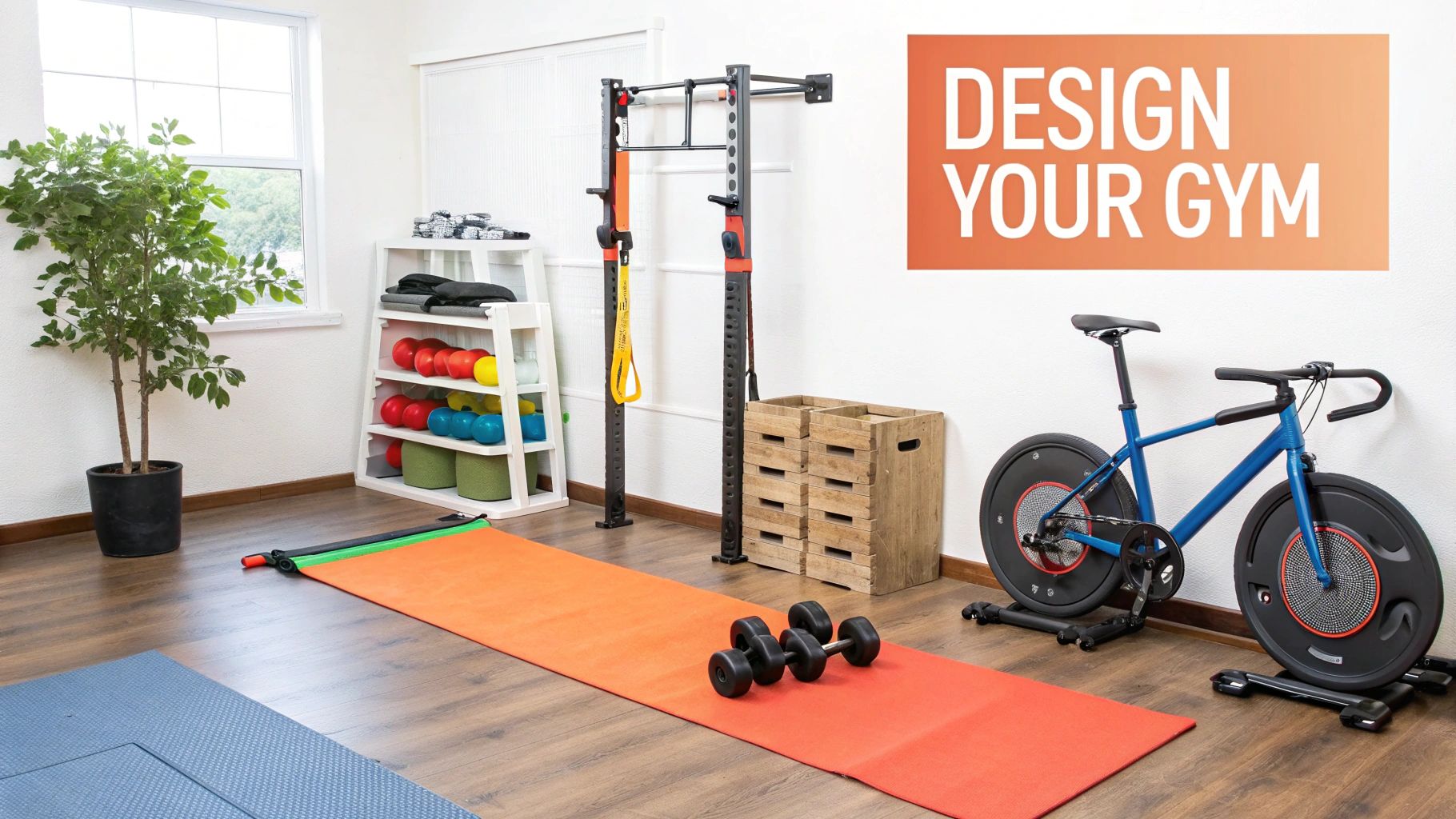
Alright, you’ve picked out your gear. Now for the fun part: building the space where you’ll actually use it. A well-planned workout area is much more than just a place to stash a treadmill; it’s what keeps you safe, motivated, and coming back day after day.
Think of your space as another piece of equipment. It needs just as much thought as your dumbbell selection. This isn't just about unboxing your new machine. You’ve got to think about the floor underneath it and the empty space around it. With a little prep work, you can create a home gym that’s not only effective but also completely safe for you and your family.
The floor is your gym’s first line of defense. Let's be honest, your standard carpet or hardwood wasn't built to handle a dropped 50-pound kettlebell or the constant shudder of a treadmill. The right flooring is non-negotiable—it protects both your expensive equipment and your home's structure.
Think of it like a shock absorber for your car. It cushions every impact, cuts down on noise (your family will thank you), and gives you a stable, non-slip surface to work on. This is a huge deal for preventing injuries and avoiding a cracked subfloor.
Top Home Gym Flooring Options:
Every piece of equipment has a "functional footprint." That’s not just the space the machine sits on, but all the room you need around it to use it safely and effectively. Forgetting this is a rookie mistake, and a dangerous one at that.
A treadmill, for example, needs a few feet of clear space behind it. If you stumble and fall, you want to land on the floor, not fly into a wall. A kettlebell swing needs a wide, clear arc so you don't take out a lamp or a passing pet. Before you put anything together, get out the tape measure and check the manual for its specific clearance needs.
A crowded workout space is an invitation for injury. Always give yourself more room than you think you need. It’s a simple step that lets you focus on your form instead of worrying about bumping into the wall.
Your fitness equipment is a real investment. Just like a car, it needs a little TLC to keep running smoothly and safely. A simple maintenance routine can add years to the life of your gear and prevent a nasty surprise mid-workout. Just make a quick checklist and give everything a once-over once a month.
This is also where calling in a pro can be a game-changer. Sure, you can unroll a yoga mat yourself. But a complex multi-station gym or a high-tech elliptical? That’s a different story. One loose bolt or a wire that’s not quite right can lead to a broken machine or, worse, a serious injury.
When the instruction manual looks like an engineering blueprint, hiring a service like Assembly Smart is the smartest move you can make. Their experts know this stuff inside and out. They’ll make sure every single part is tightened and secured correctly, giving you the peace of mind to just focus on getting a great workout.
Owning a great piece of fitness equipment is a fantastic first step, but the real magic happens when you start using it. Think of your new gear as a tool; a solid workout plan is the instruction manual that turns that potential into real, tangible progress. The name of the game is building a consistent routine you can actually stick with.
To help you hit the ground running, we've sketched out three different workout plans below. Each one targets a specific fitness goal and uses the kind of equipment most people have at home. Consider these your launching pad—follow them exactly, or tweak them as you get stronger and more confident.
This workout is all about getting the biggest bang for your buck in the shortest amount of time. It mixes intense cardio bursts with classic bodyweight moves to torch calories and fire up your metabolism. It’s the perfect solution for those busy days when you need to squeeze in a killer workout.
This plan is designed to build a solid base of strength across your entire body using just adjustable dumbbells and resistance bands. Your focus here should be on slow, controlled movements and perfect form to really make your muscles work.
Once your strength gear is all set up—and getting professional assembly for your fitness equipment is a smart move to make sure it's done right—a structured plan is your best friend. For anyone with a barbell and rack, a proven program like the Stronglifts 5×5 Full Body Strength Program is an excellent way to guide your progress.
Building strength isn’t about lifting crazy heavy every single day. It’s about consistently challenging your muscles with good form, which is the signal your body needs to adapt and get stronger over time.
This circuit is designed to be kind to your joints while still giving you an effective workout. It’s a great option for active recovery days, for beginners, or for anyone looking to build a sustainable fitness routine they can do for years to come.
Even with the perfect plan, it's natural to have a few last-minute questions before you pull the trigger. Investing in home fitness gear is a big decision, and you should feel completely confident about it. Let's walk through some of the most common things people ask to clear up any final hesitations.
Getting these answers straight helps you go from just thinking about a home gym to actually building one you’ll be excited to use for years.
When you're trying to get the most bang for your buck in a tight space, you can't go wrong with either a quality set of resistance bands or a pair of adjustable dumbbells. Both give you an incredible amount of workout variety while taking up almost no room.
The best pick really comes down to your main goal. If you're aiming for overall fitness and toning, bands are fantastic. If you're focused on more serious muscle-building, adjustable dumbbells are the clear winner.
Here's the secret: consistency isn't about raw willpower; it’s about building smarter habits. You have to make starting your workout so easy that it’s harder not to do it.
First, put your equipment somewhere you can see it and get to it easily. If your yoga mat is already rolled out or your bike is ready to hop on, you've just removed the biggest barrier—getting set up. Second, take the guesswork out of your routine by following a structured program from a fitness app or an online trainer.
Staying motivated is less about some magical burst of inspiration and more about systematically removing obstacles. Make your workout space inviting and your routine simple, and consistency will take care of itself.
Finally, block out your workouts on your calendar just like any other important appointment. And don't forget to track your progress! Nothing fires you up quite like seeing yourself get stronger, faster, or more flexible week after week.
This really boils down to your budget, your space, and what kind of workouts you actually enjoy. An all-in-one smart machine can be a brilliant, space-saving investment if you love guided, tech-heavy workouts and have the money for it.
On the other hand, picking up several individual items—like dumbbells, a bench, and a pull-up bar—gives you a ton more flexibility to customize your workouts and is almost always the more budget-friendly route. For most people just starting out, buying a few high-quality, single-purpose items is a much safer bet. You can always add more gear down the road once you figure out what you truly love to do.
When you've invested in a complex piece of fitness equipment that needs precise setup, don't risk injury or a wobbly machine by trying to build it yourself. The experts at Assembly Smart can make sure every bolt is tightened and every part is put together safely and correctly. That way, you can focus on your fitness goals with total peace of mind. Get your free estimate and schedule an appointment at https://assemblysmart.com.