-
CALL US:
- (866) 952-3456

So, you're thinking about setting up that new pool table yourself? Before you dive in, let's talk about why calling in a professional is almost always the smarter play. A pool table assembler isn't just a handyman; they're a specialized technician who makes sure your big investment is built right, perfectly level, and ready for a flawless game. Going the DIY route often ends in costly mistakes, from a cracked slate to an unplayable, lumpy surface.
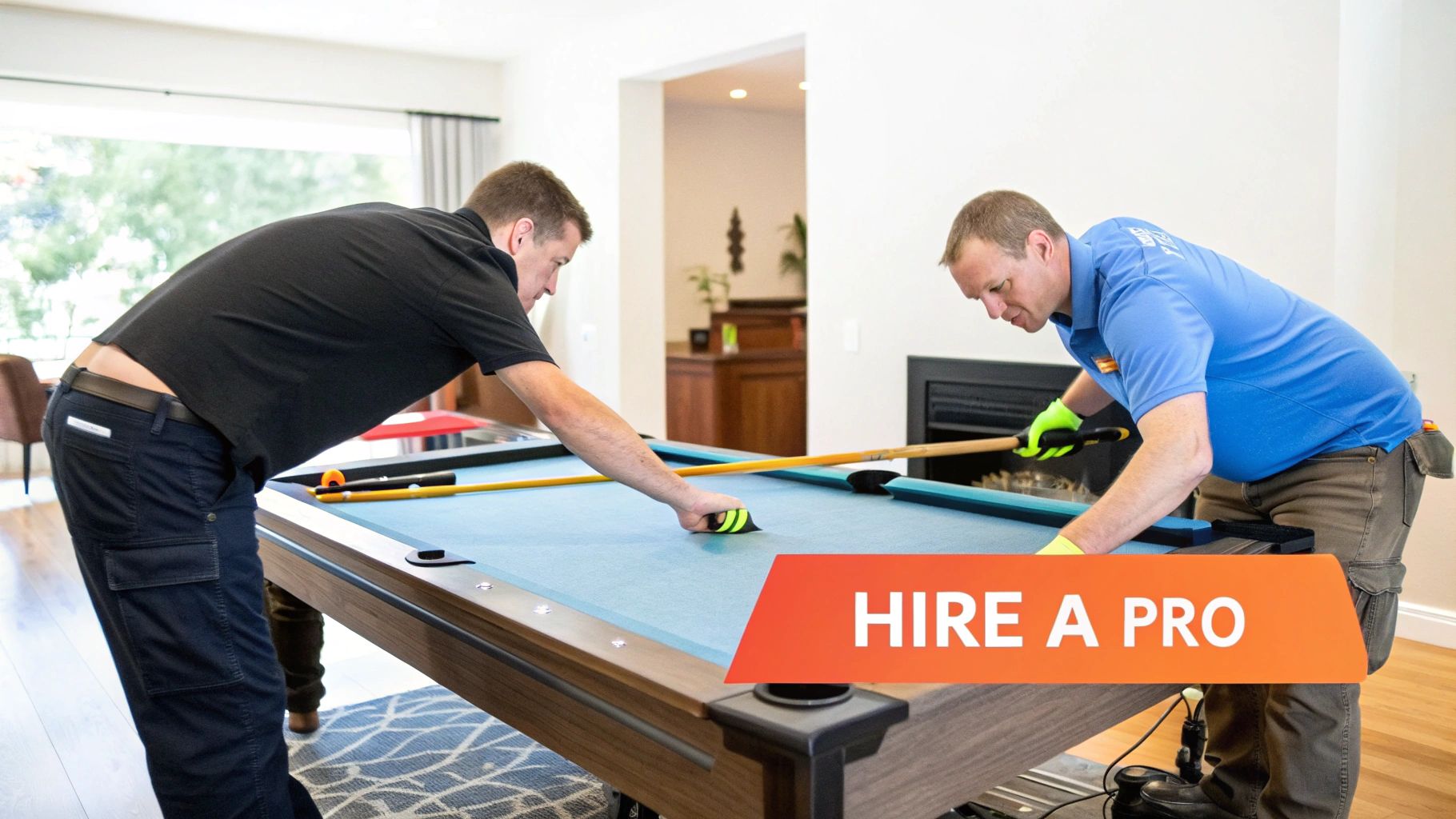
At first glance, assembling a pool table might seem like a solid weekend project. But the truth is, this is a whole different beast compared to putting together a bookshelf. A pool table isn't just a heavy piece of furniture—it’s a precision instrument where millimeters can make or break the game.
The heart of any decent table is its slate, which usually comes in three massive pieces. Each one can weigh 150-250 pounds or more. Trying to lift and position these slabs without the right dollies and techniques is a perfect recipe for a thrown-out back or a massive gouge in your new floor.
Professional installers come equipped with more than just muscle; they have the specialized tools and, more importantly, the experience. They know the secrets to joining those slate pieces so they're perfectly flush, sealing the seams with beeswax, and creating a single, glass-smooth playfield. This step alone is the foundation for how your table will play for years to come.
Here's where a pro's work really shines: leveling and felting.
A table that's even slightly off-level will cause balls to drift and roll unfairly, making a legitimate game impossible. Professionals don't just use a standard carpenter's level from the hardware store. They use a highly sensitive machinist’s level to get the slate perfectly flat across every inch, making tiny adjustments with shims until it's dead-on. If you're curious about the nitty-gritty, our guide on how to properly install a pool table breaks down the technical steps.
Stretching the felt is another task that looks easy but is anything but. It's a delicate balance. You have to pull the cloth tight enough for a fast, consistent roll, but not so tight that it rips or creates wrinkles down the line. A sloppy felting job will wear out fast and completely ruin your playing experience.
Here's a real-world horror story: A homeowner thought he could save a few bucks by assembling his new 8-foot table himself. While trying to lift one of the slate pieces with a friend, it slipped and cracked right down the middle. The cost to replace that one piece of slate—plus hiring pros to come fix the mess—ended up being nearly double what the original assembly quote was.
Still on the fence? This quick comparison should help clear things up. Deciding between a DIY project and hiring a pro comes down to weighing cost against quality, time, and risk.
| Factor | DIY Assembly | Professional Assemblers |
|---|---|---|
| Cost | Lower upfront cost (just your time) | Higher upfront cost ($300-$700+) |
| Time | Can take 8-12+ hours for a first-timer | Typically 2-4 hours for an experienced crew |
| Tools | Requires purchasing or renting specialized tools | Arrive with all necessary professional-grade tools |
| Skill Level | High. Requires precision, strength, and technical know-how | Experts with years of experience and training |
| Risk | High risk of personal injury or damage to table/home | Low risk; professionals are insured against damages |
| Final Quality | Often results in uneven leveling and poor felt installation | Guarantees a perfectly level, professional-quality playing surface |
Ultimately, hiring a professional is an investment in getting the job done right the first time, saving you from headaches and potential disasters.
At the end of the day, hiring professional assemblers is about protecting your investment. The global pool tables market was valued at a whopping USD 1.59 billion in 2024 and is only getting bigger, which means more people are buying high-quality tables for their homes. An expert ensures your table is built exactly to the manufacturer's specs, which keeps your warranty intact and guarantees it will last for decades.
Plus, any reputable assembler carries liability insurance. If they scuff a wall or scratch a floor while moving a 200-pound piece of slate, their insurance covers it, not you. That peace of mind is priceless. Professionals don’t just build a table; they deliver a perfect playing experience from the moment they leave.
Talking about money upfront is the only way to go. It prevents any awkward surprises on installation day. The cost of hiring professional pool table assemblers isn't a simple, single number—it’s a custom quote that depends on a handful of key factors. Once you get a handle on these variables, you'll know how to budget and what a fair price really looks like.
Most experienced pros will give you a flat-rate fee for a standard job. This is definitely the best and most common way to go, as you know the price is locked in, even if things take a little longer than expected. You might find someone who charges by the hour, but it's pretty rare for a standard assembly because a seasoned tech knows exactly how much time the project will take.
That flat fee should cover the whole nine yards: building the frame and legs, seaming the slate pieces, stretching the felt, and doing that final, crucial precision leveling. It’s an all-in price for a table that’s ready for the first break.
The quote you get is usually for a best-case scenario. A few things can (and often do) push that number up. The simplest way to think about it is this: the more complex and time-consuming the job, the more it's going to cost.
Want a rock-solid quote with no surprises? Be totally honest with your assembler about the access. Send them a few photos or a quick video of the path—especially any stairs, tight corners, or doorways. It’s the single best thing you can do to avoid surprise fees on the day of the job.
While prices will shift based on where you live and who you hire, they generally fall within a predictable range. This helps you sniff out a quote that's way too high or suspiciously low.
For a standard assembly of a brand-new or already disassembled table, you can expect to pay somewhere between $300 and $700. This assumes a typical 3-piece slate table and a room with decent access.
A full pool table move is a much bigger job. It involves taking the table apart at the old place, transporting it safely, and then doing a complete reassembly at the new location. This is a more involved service, and prices usually land in the $450 to $900 range. The final cost depends heavily on the mileage between the two spots and, of course, any stairs.
And what if you just want to freshen up your table with new cloth? A refelting service typically runs between $250 and $500. The type and quality of the felt you choose will nudge that price up or down. The same factors that influence assembly costs apply here, too. For a more detailed breakdown, our comprehensive guide on furniture assembly service costs goes into even more detail.
When you understand the pricing structure and what drives the cost, you can hire pool table assemblers with confidence. You'll know you're getting quality work for a price that's fair and transparent.
Finding a great pool table technician is a lot easier when you know where to look and what to ask. The right pro brings more than just muscle; they bring precision and experience that turns a heavy box of parts into a perfect playing surface. Your mission is to find a true craftsman, not just someone who can turn a wrench.
So, where do you start? Go straight to the experts. The store where you bought the table or even the manufacturer are your best first calls. They almost always have a short list of trusted, factory-authorized pool table assemblers they recommend—after all, their own reputation is on the line.
Another goldmine for finding a great tech is your local billiard or game room supply shop. These places are the hubs of the local pool community. The staff hear all the feedback, good and bad, and can usually point you toward the most skilled and reliable people in your area.
Beyond getting a direct referral, there are a few other places you can check.
The goal here is to get a few different names so you can compare their experience, pricing, and overall vibe before you commit. The process isn't that different from hiring any other skilled tradesperson. In fact, many of the same principles in guides on hiring someone to assemble furniture apply here, too.
Once you've got a shortlist, it's time to actually talk to them. This is your chance to get a feel for their expertise and make sure they’re the right fit for your specific table. Don't be shy about getting into the details; a real professional will be happy to show you what they know.
The single most important question you can ask is: "Are you insured?" You need to specifically ask for proof of general liability insurance. This is what protects you if they accidentally damage your home, whether it’s a scraped wall or, worse, a cracked piece of slate. Never, ever hire an uninsured assembler—the risk just isn't worth the small amount you might save.
It helps to have a list of questions ready to go so you cover all your bases. If you want a solid framework for vetting any professional coming into your home, this guide on the 10 essential questions to ask contractors is a great resource.
Arm yourself with these specific questions to separate the real pros from the amateurs.
This vetting process is becoming even more important as the market changes. While American Pool Tables currently hold a dominant 50.2% market share, requiring installers to be experts on those common models, other types are gaining traction. English Pool Tables, for instance, are projected to see the fastest growth at 6.8% from 2025 to 2032. This means a good technician needs to be skilled in various configurations to meet what players want. Asking about their experience with different table types ensures they have the skills you need for your table.
A flawless installation day starts long before your pool table assemblers show up. Honestly, getting the room ready is the single biggest thing you can do to guarantee a smooth, efficient, and damage-free setup. Taking a few key steps beforehand saves you from last-minute chaos and makes sure your new table has the perfect home.
The first, and most important, job is to make sure you actually have enough room. This isn't just about whether the table's footprint fits; it’s about having enough space for a real, unobstructed game. Trust me, nothing's worse than hearing your cue stick smack the wall on your very first break.
To get this right, you have to think beyond the table itself. You need to account for the table's dimensions plus the full length of a standard 58-inch pool cue on all four sides.
Grab a tape measure and some painter's tape. Mark out the exact spot where the table will sit on your floor. Having that visual guide is a game-changer.
Now, from the edge of that taped-off rectangle, measure out another 58 inches in every direction. This bigger box you've just outlined is your true "play space." Is it totally clear of walls, support columns, bulky furniture, or doorways?
A classic rookie mistake is underestimating the space needed for a full, proper stroke. If your cue hits a wall, your game is compromised from day one. It’s always better to get a slightly smaller table that fits the room perfectly than to shoehorn a bigger one into a space that's just too tight.
To give you a clearer picture, the table below lays out the minimum room dimensions you'll need for the most common table sizes.
This chart shows the minimum room size you'll want based on standard table and cue sizes. The 58" cue is the most common, so pay close attention to that last column.
| Table Size | Room Size with 48" Cue | Room Size with 52" Cue | Room Size with 58" Cue (Standard) |
|---|---|---|---|
| 7-Foot (3.5' x 7') | 11' 11" x 15' 5" | 12' 7" x 16' 1" | 13' 5" x 16' 9" |
| 8-Foot (4' x 8') | 12' 4" x 16' 5" | 13' x 17' 1" | 13' 10" x 17' 9" |
| 9-Foot (4.5' x 9') | 12' 11" x 17' 5" | 13' 7" x 18' 1" | 14' 5" x 18' 9" |
Before the assemblers even get on the schedule, it’s vital to properly plan your room layout effectively to ensure you have plenty of elbow room for both the table and comfortable play.
Keep in mind, your assembly crew will be hauling multiple pieces of slate, and each one can weigh between 150 to 250 pounds. It's on you to give them a wide, totally clear path from their truck all the way to the game room.
Doing this prep work makes the job safer and way faster for the crew. For a few more tips, check out our guide on how to prepare for your furniture assembly project. By having the room measured, cleared out, and protected, you're setting the stage for a perfect installation.
Knowing what to expect on assembly day can turn a potentially stressful event into an exciting one. It’s the day your investment transforms from a stack of heavy components into a precision playing surface. When the pros arrive, they follow a time-tested process. Let's walk through what that looks like so you can recognize quality workmanship when you see it.
The first thing the team will do is a quick walkthrough. They'll confirm the final spot for the table and double-check the path you've cleared to make sure they can bring in the heavy pieces safely. This is really your last chance to tweak the table's orientation before the build starts.
Once everyone gives the green light, the real work begins. They’ll start by bringing in the components, usually laying down protective blankets to keep your floors safe. The first major step is building the table’s foundation—the frame and legs. They'll assemble the cabinet, attach the legs, and make sure everything is perfectly square and sturdy. Only then will they add the real weight.
This is where you can really tell the difference between an amateur and a seasoned pro. The slate, typically arriving in three perfectly matched pieces, is the soul of your table. Each slab can weigh a hefty 150-250 pounds, so the crew will use specialized dollies to carefully bring them in and set them on the frame.
They don't just drop the slate into place, though. The installers will meticulously position each piece to ensure a perfect, tight fit. Then comes the most critical step: they level the slate itself, completely independent of the frame, using shims and a high-precision machinist's level. This guarantees the playing surface is dead flat before the felt is even unrolled.
With the slate perfectly level, they address the tiny gaps between the pieces.
This detailed process flowchart shows a simplified version of the initial prep work required before the assemblers even arrive, covering the essentials of measuring, clearing, and protecting the room.
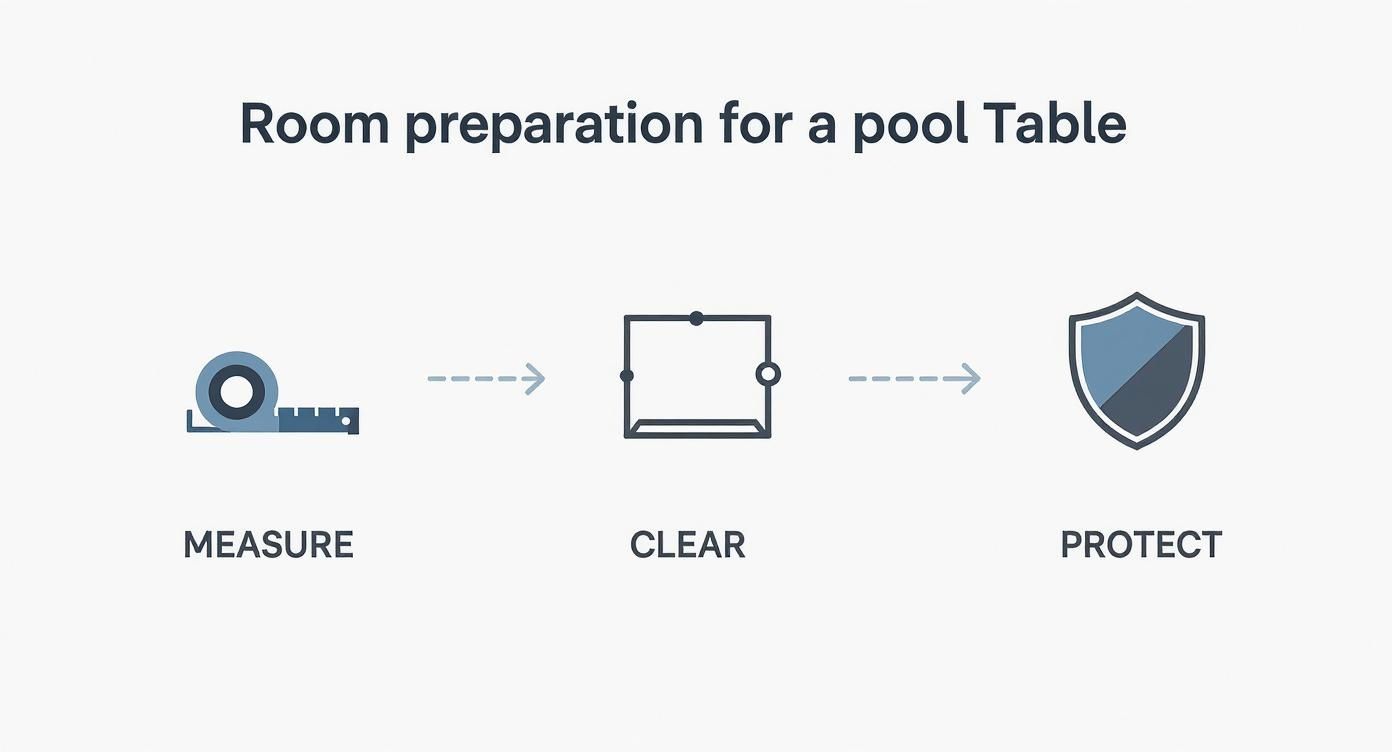
As you can see, getting the room ready isn't just a small task—it’s a foundational part of a successful assembly that makes the whole process safer and more efficient.
With the slate perfectly seamed and leveled, it's time to stretch the felt. Again, this is an area that separates the pros from the rest. They'll lay the cloth over the slate and then meticulously stretch and staple it underneath. The goal here is a taut, completely wrinkle-free surface that gives you a fast and true ball roll.
A professional installer knows the exact tension needed for your specific type of cloth. Too loose, and the balls will roll slow and the cloth will wear quickly. Too tight, and you risk tearing the fabric at the staples or pockets.
Once the main playing surface is felted, they move on to the rails. They'll cover each rail with the matching cloth and attach them securely to the table, making sure every bolt is tight and the alignment is perfect. They're looking for tight pocket openings and a consistent, lively rebound from every single cushion.
The entire process is a global craft. It's interesting to see how demand for skilled assemblers is growing, especially as the Asia-Pacific region has become the fastest-growing market for pool tables. In fact, the coin-operated segment alone in this region accounted for 21.86% of the global market in 2025. This just goes to show how many different types of tables are out there. You can actually discover more insights about the growing global pool table market and see how these trends are shaping the industry.
The very last step is the final, all-encompassing leveling check. Now that the table is fully assembled and carrying its total weight, the assemblers will place their machinist's level all over the completed table. They check it lengthwise, widthwise, and diagonally, making tiny adjustments to the leg levelers until that bubble is perfectly centered, no matter where they put it.
To wrap things up, they’ll give the table a final brushing to clean off any chalk dust or debris from the installation. A good crew will then hand you a piece of chalk, roll a few balls to show off the table’s perfect roll, and stick around to answer any last-minute questions you have.
From start to finish, a standard assembly takes about 2 to 4 hours. At the end of it, you’re left with a professionally built table, ready for years of enjoyment.
Once you’ve lined up a great technician and prepped the room, a few last-minute questions usually pop into your head. Getting these answered ahead of time is the key to a predictable, stress-free installation day. Let's run through some of the most common things homeowners ask when working with professional pool table assemblers.
Knowing the logistics around timing, tipping, and troubleshooting is just as important as the assembly process itself. It ensures there are no surprises when the crew shows up.
This is always the first question, and for good reason—you want to know how long your room will be a "work zone." For a standard three-piece slate table, you can generally expect a professional assembly to take between 2 to 4 hours. This is a solid estimate for a new table or one that's been previously disassembled, assuming access to the room is straightforward.
Of course, a few things can stretch out that timeline.
When you book the appointment, just ask your assembler for a time estimate. A true pro can look at the details of your table and home layout and give you a very accurate idea of the duration.
While a tip is never officially required, it's a very common—and very appreciated—gesture for a job well done. You have to remember, this isn't just a simple assembly job. It's incredibly demanding physical labor that requires a high degree of precision and skill. These techs are carefully maneuvering hundreds of pounds of delicate slate inside your home.
If the crew was professional, efficient, and took great care with your table and your property, a tip is a fantastic way to show your appreciation.
As a rule of thumb, tipping somewhere around $20 to $40 per person on the crew is a great starting point. You can adjust that based on the job's complexity, the quality of the work, and your overall satisfaction.
Let me be crystal clear on this one: absolutely not. A slate pool table should never, under any circumstances, be moved in one piece. Not even a few inches across the room.
Trying to lift, slide, or roll a fully assembled table is a guaranteed recipe for disaster. The immense weight of the slate puts so much stress on the frame—which was never designed to support that load while in motion—that you can easily crack the wood, pop the slate seams, and completely ruin the table's level.
The only correct way to move a slate table is to have a professional completely disassemble it, move each component individually, and then reassemble and level it perfectly in its new spot.
This is exactly why you must verify their insurance before hiring anyone. Accidents are rare with pros, but they can happen. Reputable pool table assemblers will always carry general liability insurance to cover any accidental damage to your home or property.
This insurance is your safety net, protecting you from costs related to things like:
Before you hire, insist on seeing proof of insurance. If you hire an uninsured handyman and they cause damage, you could be on the hook for all the repair costs yourself. A true professional stands behind their work and has the right coverage, giving you complete peace of mind.
Ready to skip the hassle and ensure your pool table is assembled perfectly the first time? The expert technicians at Assembly Smart have the tools, experience, and insurance to get the job done right. We offer transparent pricing and convenient scheduling to make your installation experience completely stress-free. Book your professional pool table assembly today!