-
CALL US:
- (866) 952-3456

When you're looking for affordable handyman services near me, the first instinct is usually to pop that exact phrase into Google. But honestly, the best, most reliable folks often aren't the ones with the biggest ad spend.
The real gems? They’re usually found through hyper-local sources—think community social media groups and direct recommendations from neighbors who can vouch for quality work and fair prices.
Finding a dependable handyman who won’t break the bank can feel like a real chore. While big platforms like Thumbtack or Angi are convenient, they often tack on service fees that quietly inflate your final bill. The best value is almost always found when you tap into your local community network.
This is where a smarter search strategy comes in handy. Instead of just a generic search, you need to think more granularly. Community-focused platforms are absolute goldmines for unfiltered, honest feedback.
Your neighbors are your secret weapon. Chances are, they’ve hired help for projects just like yours and can give you a direct referral to someone they trust. This route often leads you to independent pros who rely on word-of-mouth instead of flashy marketing, and those savings get passed on to you.
Here are a few powerful local sources to get you started:
This infographic breaks down the whole process, from casting a wide net to zeroing in on the right person for the job.
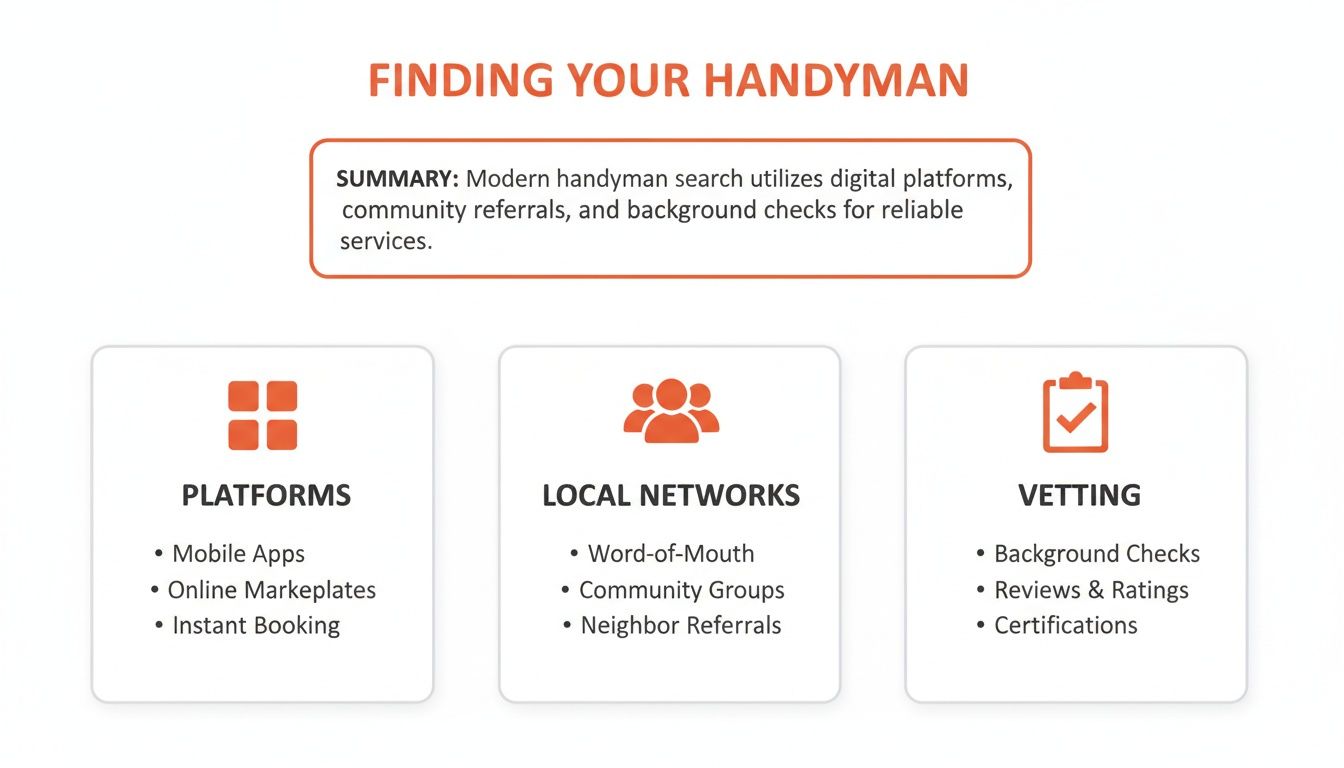
As you can see, a successful search is a mix of using modern tools and good old-fashioned community word-of-mouth, followed by doing your own homework on the candidates.
Navigating the options can be confusing, so let's break down where to look. Each platform and method has its own set of pros and cons, catering to different needs and project types.
| Platform / Method | Best For | Potential Pros | Potential Cons |
|---|---|---|---|
| Thumbtack / Angi | Quick searches & getting multiple quotes fast. | User-friendly interface, verified reviews, wide variety of services. | Service fees can increase costs; may favor larger companies. |
| TaskRabbit | Small, specific, single-person tasks (e.g., hanging a TV). | Upfront hourly rates, clear task categories, easy booking process. | Can be pricey for larger projects; quality can vary widely. |
| Nextdoor / Facebook | Vetted, word-of-mouth recommendations. | Access to trusted local pros, honest feedback from neighbors. | Slower process, requires you to initiate contact and vetting. |
| Local Hardware Stores | Finding seasoned, independent professionals. | Referrals are often for highly experienced, no-nonsense pros. | Less formal process; may not have an online presence to review. |
Ultimately, the best approach is often a combination of these methods. Start with a local recommendation, then cross-reference with any online profiles or reviews you can find.
Right now, your goal isn’t to hire someone on the spot. It's to build a solid list of three to five potential candidates. Getting this right is more important than ever. The demand for skilled help is booming—the global handyman service market was valued at around USD 421.4 million in 2023 and is expected to explode to over USD 1.1 billion by 2032. With U.S. homeowners projected to spend a staggering $509 billion on home improvements and repairs in 2025, finding the right pro is crucial.
A strong candidate list is your best defense against overpaying. When you have multiple options, you're in a much better position to compare quotes and find a professional who offers a fair price for quality work.
To help streamline your search, you can check out a detailed guide to finding and hiring professionals near you. As you collect names, I'd recommend creating a simple spreadsheet to track their contact info, who recommended them, and any quick notes. This little bit of organization now will make the next step—vetting each candidate—so much easier.

Before you can feel confident about hiring help, you need to understand how they charge. It's the only way to compare quotes apples-to-apples and avoid that sinking feeling when the final bill is higher than you expected.
You'll almost always run into two main pricing models: hourly rates or a flat fee for the whole project. Each has its pros and cons, and picking the right one for your job can save you some real money.
Hourly rates are perfect for smaller, unpredictable jobs or when you have a laundry list of different tasks. Let's say you need someone for a few hours to hang some shelves, tighten a wobbly doorknob, and patch a small hole in the drywall. An hourly rate is the most straightforward approach here. The pro gets paid for their time, and you don't need three separate quotes for three tiny jobs.
Flat-rate fees, on the other hand, are your best friend for well-defined projects where the scope is crystal clear. Think assembling a big IKEA wardrobe or installing a new ceiling fan. For jobs like these, a handyman can confidently estimate the time and effort needed and give you one single, all-in price. No surprises, no watching the clock.
Pro Tip: A picture is worth a thousand words—and maybe a few bucks off your quote. Always send clear photos or a quick video of the project when asking for an estimate. It helps the handyman give a much more accurate price, which means fewer "adjustments" later on.
So, what actually goes into that number they give you? Several things can swing the price of affordable handyman services near me. A seasoned pro with 20 years of experience is naturally going to charge more than a newcomer. The job's complexity is another huge piece of the puzzle; fixing a simple leaky faucet is a world away from replacing an entire bathroom vanity.
Here are the key things that influence what you'll pay:
Getting familiar with the average handyman hourly rate in your specific area is a smart move. It gives you a solid baseline to judge whether a quote is fair, suspiciously low, or way out of bounds.
The handyman industry is a massive part of our economy. By 2025, the U.S. market is expected to be a $273.6 billion industry, with over 522,800 businesses. That's a lot of competition, and it's created a huge opportunity for services that offer clarity and value, especially for busy people who aren't DIY experts.
This is exactly why specialized companies like Assembly Smart, which focus on specific tasks like putting together furniture, fitness equipment, or playsets, are gaining so much ground. They offer transparent, upfront pricing—with clear hourly rates starting at $69—that takes all the guesswork out of the equation.
When you know the cost before the work even starts, you can hire with total confidence. No more hidden fees or surprise charges on the final invoice. Just simple, predictable pricing.

Okay, you've got a solid shortlist of potential handymen. Now comes the most important part: screening each one. This vetting process is what separates a smooth, successful project from a homeowner’s worst nightmare.
It's not just about finding someone who can do the job. You need a professional who is reliable, insured, and easy to communicate with.
Think of this next step as a friendly but firm interview. Your goal is to get the facts you need to make a smart, confident decision. Don’t be shy about asking direct questions—any true professional will expect them and have answers ready to go.
When you first connect with a potential handyman, whether it's by phone or email, there are a few non-negotiable points to cover. Getting these details upfront will save you from major headaches and help you weed out the wrong people fast.
Here are the fundamentals you absolutely must ask about:
For a deeper dive, this comprehensive contractor hiring checklist is an excellent resource. It ensures you cover all your bases before making that final call.
A handyman who gets defensive or hesitates when you ask about insurance or references is a massive red flag. Your peace of mind is worth the extra time it takes to find someone who operates with complete transparency.
Online reviews are a great place to start, but you have to learn to read between the lines. Honestly, a string of vague, five-star ratings can sometimes be less helpful than one detailed three-star review that explains exactly what went right and what went wrong.
Look for patterns in what people are saying. Do multiple reviews mention the handyman was consistently late? Or did several different clients praise how clean they left the worksite? These are the details that paint a much clearer picture of what you can actually expect.
To really get a feel for this, it helps to get some insights into the 'tradies' industry and their customer review practices. Understanding their world reveals a lot about their professionalism. This level of diligence ensures the person you hire to find affordable handyman services near me isn't just cheap, but genuinely professional.
A great handyman is the Swiss Army knife of home repair, a jack-of-all-trades who can tackle a huge variety of tasks around the house. But even the best generalists have their limits. Knowing when to put down the phone to your local handyman and call in a specialist is one of the smartest things a homeowner can do.
Some jobs simply carry risks that aren't worth it without certified, specialized expertise. Think of it this way: you wouldn't ask your family doctor to perform open-heart surgery. The same logic applies to your home. For the complex, high-stakes stuff, a specialist isn't just a good idea—it's a necessity.
Certain jobs are strictly regulated for a reason—they can be downright dangerous if done incorrectly. A handyman is perfect for patching a hole in the drywall, but you don't want them rewiring your circuit breaker.
Here are a few clear-cut scenarios where you absolutely must hire a licensed specialist:
Hiring an unlicensed person for these jobs is a massive gamble. It can void your homeowner's insurance and create seriously unsafe conditions. It's a risk that never, ever pays off.
Beyond the traditional licensed trades, a new type of specialist has popped up to handle very specific, often intricate, tasks. Let's be honest: assembling modern products—from complex flat-pack furniture to heavy-duty fitness equipment—is a unique skill.
While a general handyman can probably figure it out, a dedicated assembly pro does it better, faster, and much more safely.
Companies like Assembly Smart are a perfect example of this shift. Our technicians aren't just "handy." They're true experts in assembling specific product lines from brands like IKEA, Bowflex, or Lifetime. This deep knowledge means they know the common pitfalls before they even start, show up with the exact tools needed, and can get the job done right in a fraction of the time.
For something big and important, like a multi-station home gym or a large backyard trampoline, this expertise is what ensures the final product is stable and safe for your family to use.
This trend is changing how people find help, too. The move to digital is undeniable, with online bookings expected to command 57.8% of the global handyman market by 2025. Busy homeowners want the efficiency of an online quote and the peace of mind that comes with specialized expertise—which is exactly where services like Assembly Smart come in. You can dive deeper and see the full handyman service market analysis to learn more.
For any task that requires precision and product-specific knowledge, like making home modifications for elderly residents, a specialist is always the right call.

Okay, you've done the hard part. You’ve sifted through the candidates, checked their references, and picked your pro. Now it's time to make sure the project goes off without a hitch.
Getting these final steps right—from the initial booking to the final payment—is what separates a smooth, successful project from a frustrating one. This is all about protecting yourself and the handyman, making sure there are no surprises, and guaranteeing the work is exactly what you wanted.
First things first: get it in writing. I don’t care if it’s just a small job to hang a few shelves. A simple, written agreement is non-negotiable.
This doesn't have to be some fancy, five-page legal contract. A straightforward email that confirms all the important details is usually perfect. The goal is to make sure you're both on the same page before any work begins. This simple piece of documentation is your best friend if any disagreements pop up later.
Make sure your confirmation email or document includes:
This isn't about distrust; it’s about professionalism. It protects you and shows your handyman that you're both serious about the job.
If a pro is cagey about putting the details in writing, that's a huge red flag. A trustworthy handyman will have no problem with transparency. A clear agreement shows they're confident in their work and stand by their word.
A little prep work on your end can go a long way, especially if you're paying by the hour. An organized, clear workspace means your handyman can get right to work instead of spending the first 15 minutes moving your stuff around. You're paying them for their skills, not for being a mover.
If they're coming to assemble that new dresser you bought, clear out the area where it's going to live. If they're painting, take the photos off the wall and move the little knick-knacks. It’s a simple step that saves them time and you money.
When the job is done and it's time to pay up, you need to be smart about it. The golden rule? Never, ever pay the full amount upfront.
For a bigger project, it's reasonable for a handyman to ask for a small deposit to cover materials—typically 10% to 30%. But the final, full payment should only happen after you’ve inspected the work and you're 100% happy with the results.
Steer clear of paying large amounts in cash. There’s no paper trail. Instead, use traceable methods like a credit card, check, or a secure online payment app. This gives you a record of the transaction and an extra layer of protection.
When you're evaluating different services, check out their payment policies ahead of time. For instance, you can see how straightforward it can be by viewing the clear pricing and policies for assembly services offered by companies like Assembly Smart.
Before you hand over that final payment, do a thorough walkthrough of the completed job with your handyman. Once you're satisfied, then you can settle up.
Even after you've pinpointed a few solid handyman candidates, you probably still have some questions floating around. That’s totally normal. Diving into the world of home repairs can feel a bit confusing, so let's tackle some of the most common things homeowners wonder about when they're trying to find an affordable, reliable pro.
This one's a moving target. A fair hourly rate for a handyman can swing pretty wildly depending on where you live, how much experience the pro has, and just how tricky the job is. As a general rule of thumb, you can expect to pay anywhere from $50 to $125 per hour.
Simple, quick jobs like assembling a basic bookcase or patching a small hole in the drywall will almost always land on the lower end of that range. On the other hand, more technical work that touches on light plumbing or electrical tasks is naturally going to cost more.
For highly specialized services, like the pros at Assembly Smart, you'll often find transparent pricing for specific jobs, with rates starting around $69 per hour. Your best bet is always to get a few different quotes. It's the only real way to get a feel for the going market rate right here in your neighborhood.
Yes. One hundred percent. While the specific licensing rules can change from state to state and depend on the exact work being done, you should always, always hire a handyman who carries general liability insurance. This is your single most important safety net.
Think of it this way: that insurance policy is what protects you and your home if something goes wrong, whether it's accidental damage or, heaven forbid, an injury on the job. Don't ever feel weird about asking to see proof of insurance before work starts. A true professional will have it ready to go and be more than happy to show you.
When it comes to product assembly—especially big stuff like a swing set or heavy fitness equipment—hiring an insured company isn't just a good idea, it's non-negotiable. It's the key to making sure the job is done safely and giving you total peace of mind.
Unlike grabbing a coffee, tipping isn't really an expected part of the deal with handyman services. This is especially true if the handyman owns their own business, since they're the ones setting the prices in the first place. Their fee is their compensation.
But, if they did an absolutely stellar job, went the extra mile, left the place spotless, or perfectly handled a really tough task, a tip is a wonderful way to show you noticed. A tip of 10-20% of the final bill is a fantastic gesture to show genuine appreciation for a job well done. For a technician who works for a larger company, a tip is always appreciated but never required.
Want another great way to say thanks that doesn't cost a dime? Leave them a detailed, glowing online review. You'd be surprised how much that helps their business grow.
This is a big one, and it trips a lot of homeowners up. The distinction is actually pretty simple.
A handyman is your go-to for a list of smaller repairs, general maintenance, and all those "odd jobs" that don't need a special permit. Think of things like:
A general contractor, on the other hand, is the person you call to manage big, complex projects. We're talking kitchen remodels, home additions, or major structural changes. Contractors are licensed to run jobs that involve multiple specialized trades (like plumbers, electricians, and roofers) and almost always require pulling building permits.
Bottom line: If your project is a major overhaul costing thousands of dollars, you definitely need a contractor. If you have a to-do list of smaller tasks, a handyman is the perfect person for the job.
Tired of staring at that flat-pack box? Let the specialists handle it. Assembly Smart offers professional, insured assembly services for everything from IKEA furniture to complex fitness equipment, with transparent hourly rates and next-day availability. Get your free estimate and book your stress-free assembly today!