-
CALL US:
- (866) 952-3456

Trying to pin down the cost of a custom closet can feel a lot like asking, "How much does a car cost?" Well, are we talking about a basic sedan or a luxury SUV with all the bells and whistles? The final price tag for your closet is a mix of your vision, your space, and the choices you make along the way.
The general ballpark for a professionally installed custom closet is somewhere between $1,500 and $4,500. This usually gets you a solid, well-designed system for a standard walk-in. Of course, that's just an average.
Simple projects, like outfitting a small reach-in closet, can start as low as $500. On the other end of the spectrum, a sprawling walk-in closet decked out with premium finishes, an island, and custom lighting can easily soar past $8,000. Even major players like Closets by Design quote a wide range for their walk-ins, from about $1,800 to $7,000. It all comes down to the specifics, and you can learn more about custom closet pricing factors to see what drives these numbers.
At the most basic level, your starting price is determined by two main categories: reach-in closets and walk-in closets. A simple reach-in is always going to be the most budget-friendly option. A walk-in, on the other hand, gives you more room to customize—and a much higher potential cost.
This chart gives you a good visual of the typical cost ranges for each.
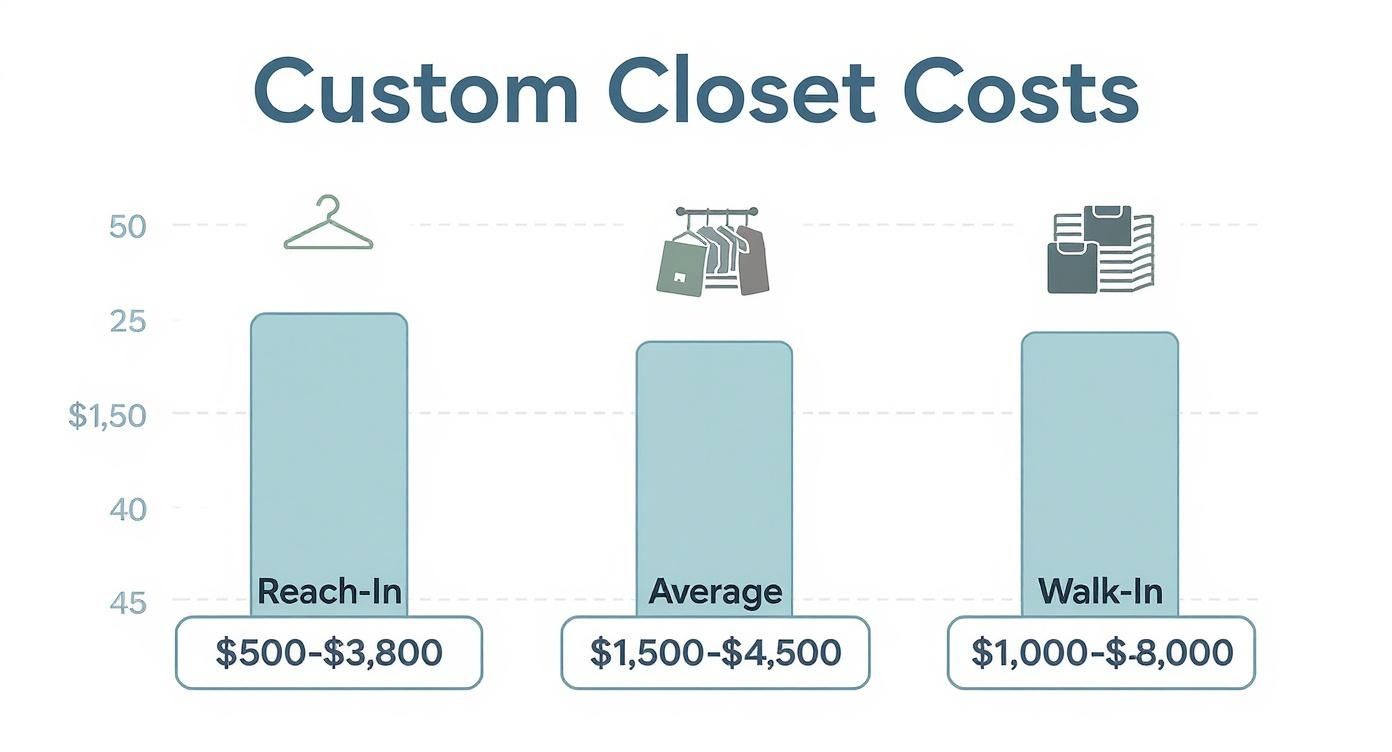
As you can see, there’s some overlap, but the ceiling for a walk-in is significantly higher. That bigger footprint just opens the door for more complex and expensive features.
To give you an even clearer picture, let's break down the numbers a bit more. The table below provides a quick snapshot of what you might expect to pay based on the closet type, its size, and the quality of the system you're aiming for.
Think of this as a starting point to help you zero in on a realistic budget before we dig into the details that can make these prices shift.
| Closet Type | Size | Basic System Cost (Prefab/Simple) | Mid-Range System Cost (Installed) | Premium System Cost (High-End Materials) |
|---|---|---|---|---|
| Reach-In | 4-6 ft Wide | $400 – $900 | $900 – $2,500 | $2,500 – $4,000+ |
| Small Walk-In | 25-50 sq ft | $750 – $1,800 | $1,800 – $4,000 | $4,000 – $7,000+ |
| Large Walk-In | 100+ sq ft | $1,500 – $3,000 | $3,000 – $6,500 | $6,500 – $15,000+ |
These ranges help illustrate how a project can scale from a simple, functional upgrade to a full-blown luxury installation. Your choices in materials and features will ultimately determine where you land.
Ever wonder why one custom closet quote comes in at $1,500 while another, which looks pretty similar, tops $10,000? The secret is in the details. It's a lot like buying a car—the base model gets you where you need to go, but once you start adding leather seats, a bigger engine, and a high-end sound system, the price tag climbs fast.
It’s the same story with your closet. Every single choice you make, from the finish on the shelves to the style of the handles, nudges the final cost up or down. Your project's price really boils down to four things: the materials you pick, how tricky the installation is, the complexity of the design, and how many premium accessories you decide you can't live without.
Getting a handle on these factors gives you the power to make smart choices. You'll know where to put your money for the biggest impact and where you can scale back without giving up on quality.
The single biggest piece of the cost puzzle is the material. This is the foundation of your entire closet system, and it sets the tone for both its look and how well it holds up over time.
For the most part, you're choosing between two main options:
When weighing your options, it helps to think about broader custom cabinetry considerations, since many of the same principles about construction and quality apply here. Your choice between laminate and wood is the first major fork in the road for your budget.
The second major driver is labor. The cost here isn't just about paying someone for their time; it's about paying for the skill and precision needed to get a perfect, custom fit.
Putting up a simple wall-mounted system in a basic rectangular closet is a lot quicker (and cheaper) than installing a floor-to-ceiling system with crown molding in a room with slanted ceilings.
Here are a few things that can bump up your labor costs:
Your room's unique quirks matter a lot. Awkward angles, strange nooks, and super-high ceilings all make the installation more complex, and that complexity will show up in the final labor quote.
This is where the "custom" part really comes to life—and where the costs can sneak up on you. A straightforward design with just open shelves and hanging rods will always be more budget-friendly than a closet packed with drawers, cabinets, and fancy features.
Think of every extra element as an upgrade. Here’s how common features affect the price:
By deciding what’s truly essential versus what’s just nice to have, you can keep a firm grip on your budget while still designing a space that’s both beautiful and works perfectly for you.
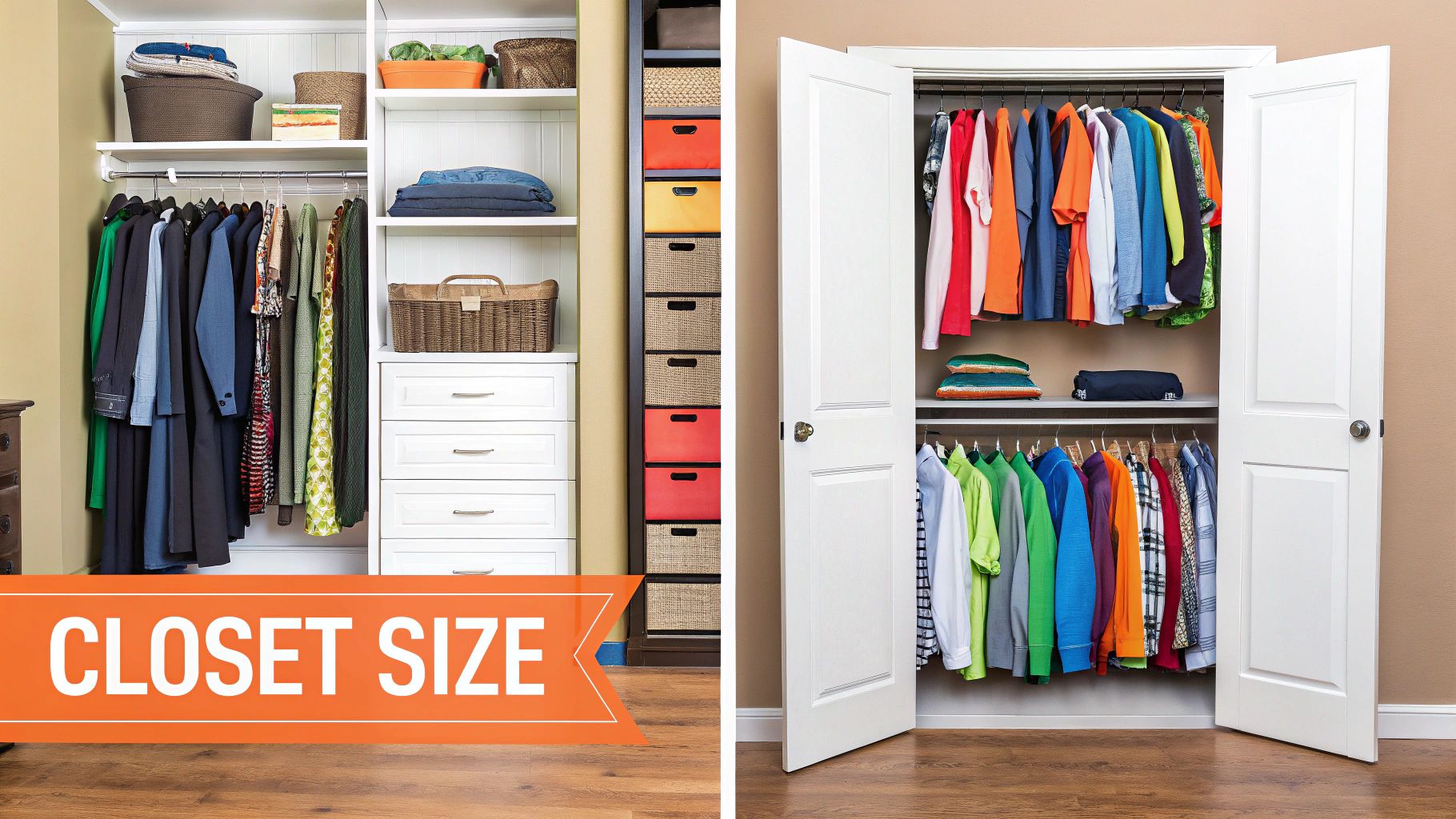
When you're trying to nail down the cost of a new closet system, the first things to figure out are simple: What kind of closet are you working with, and how big is it? Think of it like real estate—a studio apartment just isn't in the same price league as a four-bedroom house. The same logic applies here. A simple reach-in closet will have a completely different budget than a sprawling, room-sized walk-in.
These two factors, size and type, really set the stage for your entire project cost. They determine how much material you'll need, how complex the design can get, and how many hours of labor it will take to put it all together. A small project might just need a few shelves and a hanging rod, but a large one could involve entire walls of cabinetry, a center island, and fancy lighting. This is the ground floor for building a budget that makes sense.
Reach-in closets are what most of us have in our bedrooms. They're compact, efficient, and usually somewhere between four to eight feet wide. Because their footprint is smaller, the cost to upgrade them is naturally a lot friendlier on the wallet. This makes them a perfect opportunity for a high-impact upgrade without a massive investment.
For a professionally installed system in a standard 6-foot reach-in, you should plan on spending somewhere between $500 and $2,000. Where you land in that range depends on what you put inside. A simple setup with basic shelves and rods will keep you on the lower end, but if you start adding things like a bank of drawers or premium finishes, you'll creep toward that higher number.
Walk-in closets are where the design possibilities—and the budget—really open up. With all that extra space, you can get much more creative, from simple L-shaped layouts to full U-shaped designs with dedicated zones for shoes, bags, and different types of clothes.
A smaller walk-in, maybe around 50 square feet, will likely cost between $1,500 and $4,000 for a solid, mid-range system. But when you get into a large, luxurious walk-in of 100 square feet or more, the price can easily jump from $4,000 to over $8,000. Add-ons like a center island or extensive cabinetry are what really drive that cost up.
The price jump from a reach-in to a walk-in isn't just about needing more wood and screws. It's a totally different level of complexity. A walk-in is basically a small room, which means a more thoughtful design, a more involved installation, and a lot more of the expensive components like drawers and cabinets.
To give you a clearer picture, let's break down how these costs compare side-by-side.
| Closet Type / Installation | Typical Size | DIY / Prefab System Cost | Professionally Installed Cost | Key Considerations |
|---|---|---|---|---|
| Reach-In Closet | 4 to 8 feet wide | $200 – $1,000 | $500 – $2,000 | Best for budget upgrades. Professional installation adds labor but ensures a perfect fit. |
| Walk-In Closet | 50 to 100+ sq. ft. | $800 – $3,000 | $1,500 – $8,000+ | Complexity and features (islands, drawers) dramatically increase professional install costs. |
This table shows how the numbers shift not just with size, but with who does the work. Going the DIY route can definitely save you money, but a professional install guarantees it's done right and often much faster.
Beyond the closet itself, your zip code has a surprisingly big impact on the final bill. Labor rates and material costs are not the same everywhere, and those differences will show up in your quotes.
For example, a 35-square-foot closet in a major metro area like New York, NY, might run you $1,000 to $2,300. But for that exact same project in a city like Toledo, OH, you’re looking at a much more affordable $400 to $1,000. And if your closet has weird angles or unused corners, expect the labor cost to jump by about 15–20% to deal with the extra complexity.
If you want to keep costs in check, a great strategy is to buy a high-quality modular system yourself and then hire a pro just for the installation. You get that custom-closet feel without the full custom-closet price tag. If you're leaning that way, you might find some useful tips in our guide on how to build a closet organizer.
Once you start shopping for a custom closet, you'll see pretty quickly that not all companies are the same. The options are all over the map, from high-end, full-service brands to budget-friendly retail giants offering modular systems. Figuring out their different approaches and price points is the key to getting what you want without blowing your budget.
Think of it like buying a suit. You could get a bespoke, tailor-made suit from a top designer, a solid off-the-rack option that a tailor tweaks for you, or a perfectly good suit from a department store that you wear as is. Each one has its place, but the experience, quality, and cost are worlds apart. It's the exact same story in the world of custom closets.
At one end of the spectrum, you have the full-service, luxury brands. At the other, you’ve got the DIY-friendly, modular solutions.
Companies like California Closets and Closets by Design are at the top of the market. They deliver a completely hands-off, white-glove experience. The whole thing usually kicks off with a free in-home design consultation. A professional designer comes out, measures your space, talks through what you need, and whips up a 3D rendering of your dream closet.
From there, they handle absolutely everything: manufacturing the custom parts, delivery, and professional installation. This is the "done-for-you" path, and it comes with premium materials, tons of customization options, and the peace of mind that experts are running the show. Of course, that level of service comes with a higher price tag. Projects often start in the low thousands and can easily climb much, much higher depending on how complex the design is and the materials you pick.
Major home improvement stores like The Home Depot offer a great middle-of-the-road option. They provide professionally designed and installed closet systems that balance quality with a more accessible price. While maybe not as completely bespoke as the luxury brands, they're a huge upgrade from basic wire shelving, using good-quality materials and a solid range of useful accessories.
For example, high-end brands like California Closets can run anywhere from $175 to over $1,800 per linear foot. Total project costs start around $1,000 and can soar past $11,000 for top-tier designs and installations. The Home Depot’s offerings, by comparison, often start around $1,500 and can go up to $20,000 for complex designs with premium materials.
This is the perfect route for homeowners who want a professional result without the premium cost of a fully specialized company.
At the most affordable end are the modular systems from retailers like IKEA, especially their famous PAX wardrobe system. This is the hands-on, DIY approach. You design the closet yourself with their online tools, buy the flat-packed boxes, and then you're in charge of getting it home and putting it all together.
The IKEA PAX system is the undisputed king of budget-friendly closet organization. It gives you the power to create a highly functional, customized layout for a fraction of the cost of professionally installed systems. The trade-off is your own time and labor.
The savings here are massive because you're taking on the job of designer, project manager, and installer all at once. It definitely requires some sweat equity, but the end result can be a surprisingly stylish and effective storage solution. Let's be honest, though—the assembly process can be a real headache. If the idea of building it yourself sounds awful, you can find a happy medium by looking into the cost of professional IKEA furniture assembly. You get that custom feel without the custom-built price tag.
When you’re staring at quotes that can easily run into the thousands, it’s fair to ask the big question: is this closet actually a good financial move? Sure, the thought of a beautifully organized space is thrilling, but you need to know if it adds real, measurable value to your home.
The answer is a resounding yes. A well-designed custom closet is so much more than a personal luxury—it's a strategic home improvement that directly boosts your property's appeal and value. Think about it: when potential buyers are walking through a house, what’s one thing they always check? Storage.
A messy, cramped closet can be a major red flag, screaming that the home just doesn't have enough space. On the flip side, a thoughtfully organized custom closet instantly makes a primary suite feel more luxurious, functional, and spacious. That powerful first impression can be the very thing that makes your home unforgettable.
While having an organized space feels fantastic, it's the financial return that really cements a custom closet as a smart investment. Industry data consistently shows that this upgrade delivers when it's time to sell.
On average, custom closets offer a strong ROI, often bringing a 50% to 60% value boost at resale. That impressive return is a big reason why so many homeowners take the plunge, even with the upfront cost. You can get more insights on how closet costs translate to value on georgeconstructions.com.
What does that look like in real dollars? A $5,000 custom closet could easily add $2,500 to $3,000 to your home's final sale price. You're effectively turning a portion of your expense into a real asset, which is something you can't say about every home renovation. To see just how much smart improvements can transform a property's appeal, it's worth checking out different home staging transformations.
Think of a custom closet as a permanent piece of high-end staging. It doesn't just look good for photos; it solves a real problem for future owners and communicates a message of quality and thoughtful home maintenance.
Beyond the hard numbers, the day-to-day benefits of a custom closet pay you back every single morning. The value of starting your day in a calm, orderly space instead of a chaotic, stressful one is practically immeasurable.
Just consider these daily returns:
In the end, knowing what a custom closet costs is just one part of the story. When you add up the solid financial ROI and the huge improvement to your daily quality of life, it becomes clear that a custom closet is one of the smartest investments you can make. It’s an upgrade that pays for itself in both property value and personal well-being.
Dreaming of that perfectly organized, custom closet doesn't have to come with a nightmare price tag. It's all about making smart, strategic moves—knowing where to spend your money for the biggest impact and where you can save without sacrificing the function you need.
Think of it like booking a vacation. You could go first-class all the way, or you could find an amazing boutique hotel and fly economy. Both trips get you to your destination, but the final bill looks drastically different. The same logic applies when you're trying to figure out how to get the closet you want within your budget.
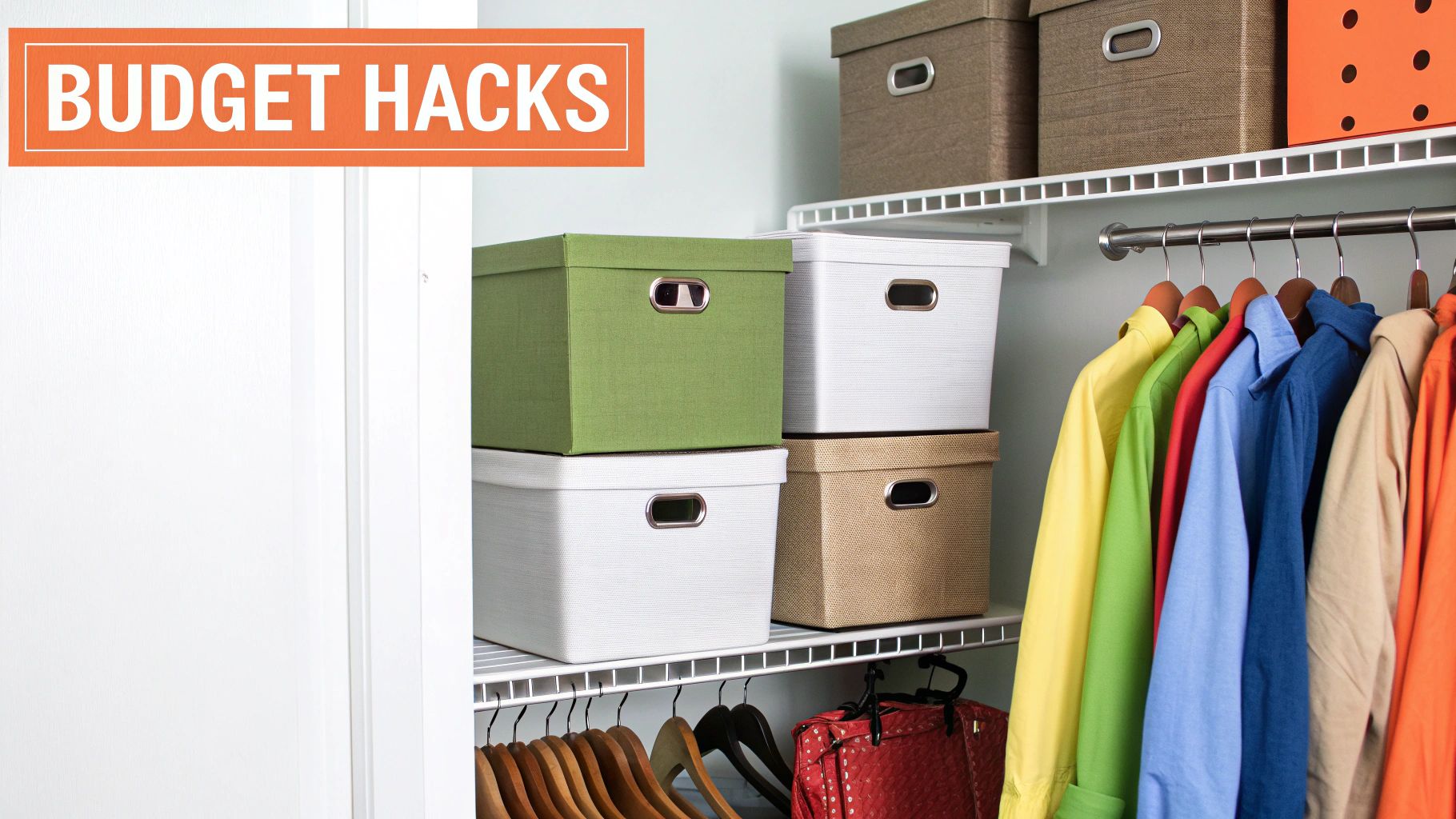
One of the easiest ways to get costs under control is by being smart about your materials and the type of system you choose. Sure, solid wood is gorgeous, but a high-quality laminate gives you incredible durability and a massive range of finishes for a fraction of the price.
The structure of the closet itself is another huge area for savings. A wall-mounted system, which hangs from a heavy-duty steel rail bolted to your wall studs, is almost always less expensive than a floor-mounted design. It simply uses less material and is often much faster to install, which cuts down on those all-important labor costs.
Here's an easy win for your wallet: stick with standard finishes. A classic, clean white is timeless and will always be more affordable than custom colors or fancy textured wood grains.
It's so easy to get wowed by all the cool accessories, but every valet rod, pull-out tie rack, and velvet-lined jewelry drawer adds up. To keep the initial price down, focus on the absolute core of what makes a closet work: tons of hanging space and good, solid shelving. These are the components that give you the biggest organizational bang for your buck.
You can also think about the project in phases:
This approach lets you spread the cost out over time, making a full-blown custom system feel much more manageable. You get the closet you've always wanted without the immediate financial hit.
A hybrid approach often hits that sweet spot between saving money and getting a high-quality result. You can buy a great modular system from a place like IKEA and then hire a professional just for the assembly. This can save you a ton compared to a full-service custom closet company, which bakes design fees and project management costs right into their price.
If you’re a confident DIYer, you can absolutely tackle the installation yourself. But for most of us, bringing in an expert ensures the final product is flawless, sturdy, and looks like it was always meant to be there. If you're curious about this middle-ground option, you can learn more about what it costs to hire someone to assemble furniture and see how it stacks up. It’s a fantastic way to control material costs while still getting that professional-grade finish.
Thinking through a custom closet project always brings up a bunch of questions. To help you get a clearer picture, let's tackle some of the most common things homeowners ask when they're figuring out the budget and what the whole process looks like.
The timeline really hinges on how complex your design is. A simple, wall-mounted system for a reach-in closet can be a surprisingly quick job for a pro, often wrapped up in just 4 to 6 hours.
On the other hand, if you're dreaming of a sprawling walk-in with a center island, lots of custom cabinets, and built-in lighting, you're looking at a more involved installation. That kind of project could easily take a dedicated crew 2 to 3 days to complete. From the very first design chat to the final walk-through, the entire process usually takes about 4 to 8 weeks, mostly depending on how busy the company is and how long it takes to manufacture your parts.
Absolutely. Going the DIY route with a kit from a place like IKEA or The Home Depot is almost always the cheapest way to go. You're cutting out the big-ticket items: professional design and labor costs.
The trade-off, of course, is your own sweat equity. You'll need the time, the tools, and a bit of patience. A fantastic middle-ground we see all the time is buying a modular system yourself and then hiring a pro just for the assembly. It's a smart move that saves you a ton of cash compared to a full custom job but still leaves you with a sturdy, perfectly built closet.
Probably not. For most closet makeovers that just involve installing shelves, drawers, and rods inside the existing space, you won't need to worry about a permit.
But, if your plans get a little more ambitious, you'll likely need one. This includes any structural work like moving or knocking down walls, running new electrical lines for lighting, or changing the room's basic layout. When in doubt, a quick call to your local building department is always the best first step.
The price tag on a custom closet is driven by the parts that demand the most material and skilled labor. The biggest culprits are usually:
Ready to get that professional, high-end look without the custom price tag? Assembly Smart can expertly put together your IKEA PAX system or any other modular closet you've picked out. Get a free, no-nonsense quote today and let us build your dream closet for you. Get Your Free Estimate from Assembly Smart