-
CALL US:
- (866) 952-3456

When you ask, "how much does a service cost," for something like item assembly, the honest answer is always: it depends. A simple bookshelf might run you under $100, but a sprawling backyard playset could easily climb into the hundreds. There's just no single price that fits every job.
Before we get into all the little details that can shift the final price, it’s really important to get a handle on the two main ways assembly companies bill for their work. Knowing this from the start gives you a framework for everything else and helps you pick a service that actually fits your budget.
You'll almost always run into one of two pricing models:
Here at Assembly Smart, we only use a flat-rate model. We just think it’s the most straightforward and fair way to do business. It gives you complete transparency and protects you from any surprise charges. We give you a fixed price based on the exact item you need built, so you know the total cost before our technician even rings your doorbell.
To give you a real-world starting point, it helps to look at the typical price ranges for some of the most popular items we see. Of course, every project has its own quirks, but these numbers should give you a realistic baseline. For a much deeper dive, you can check out our guide on the average furniture assembly service cost, which really breaks down how we get to these numbers.
The real beauty of a flat-rate fee is budget certainty. You're not paying for a technician's time; you're paying for a finished, correctly assembled product. This takes all the financial risk off your shoulders if a project ends up being trickier than expected.
To get you started, here’s a quick look at what you can generally expect to pay for some common assembly jobs.
This table gives a ballpark idea of our flat-rate costs for different types of items. Think of it as a helpful guide, not a final quote.
| Item Type | Average Price Range |
|---|---|
| Standard IKEA Furniture (e.g., small dresser, desk) | $90 – $200 |
| Large Outdoor Trampoline | $150 – $350 |
| Standard Gas Grill (2-4 burners) | $120 – $250 |
| Basic Fitness Equipment (e.g., exercise bike) | $100 – $225 |
| Children's Bicycles | $80 – $150 |
Remember, these are just estimates. The final cost will always depend on the specifics of your item and the work involved.
When you're trying to figure out how much a service will really cost, it usually boils down to one of two pricing models: hourly billing or a flat-rate fee. In the world of assembly, you'll see both, but they create a totally different experience for you, the customer.
An hourly rate is a bit like a taxi meter stuck in rush-hour traffic. It sounds simple enough at first, but the final bill can be a wild card. If the technician hits a snag—maybe a screw is missing or the instructions are a mess—that clock just keeps on ticking, and your cost creeps up. What seemed like a bargain can get expensive, fast.
A flat-rate fee, on the other hand, is like booking a car service ahead of time. You know the total price before the job even begins. This gives you complete certainty over your budget, which is exactly why we use this model exclusively at Assembly Smart. We've put together thousands of items, so we know precisely what it takes to get the job done right.
The real beauty of a flat-rate fee is that it shifts all the risk from you to us. If the assembly takes longer than we thought, that's our problem, not yours. You’re paying for a finished, correctly built product—not just for someone’s time.
This completely removes the anxiety of watching the clock. Instead of stressing about possible delays, you can just relax, knowing the price you were quoted is the price you'll pay. It’s a straightforward system built on expertise and trust.
With a flat rate, the focus is on quality and efficiency, not just logging hours. The technician is motivated to complete the job correctly and professionally, ensuring a better result for you without any surprise costs.
Let's break down the key differences to see why one model is usually a much better deal for homeowners. While some independent handymen might prefer billing by the hour, it’s crucial to understand the potential downsides. To get a better sense of what's normal out there, you can learn more about the average handyman hourly rate and see just how much those costs can swing.
| Feature | Hourly Rate | Flat-Rate Fee |
|---|---|---|
| Cost Certainty | Low; the final price is a mystery until the job is done. | High; you know the exact total cost before any work starts. |
| Budgeting | Tough; it's easy to get hit with unexpected overages. | Simple; you can plan your expenses with confidence. |
| Technician Focus | Can be on billable hours, which might lead to slower work. | On getting the job done efficiently and correctly. |
| Risk | You take on the risk for any project delays or problems. | The service provider takes on the risk for all delays. |
At the end of the day, figuring out what a service should cost isn't just about finding the lowest advertised number. It's about getting real value, predictability, and a stress-free experience. A transparent, flat-rate fee guarantees you get exactly what you paid for—a perfectly assembled item, ready to use, with zero financial surprises.
When you get a quote for an assembly job, that final number isn't just pulled out of a hat. It’s a carefully calculated figure based on a few key things that tell us how big and how tricky the job will be. Once you understand these factors, it’s much easier to see how we arrive at your estimate and helps you give us the right info for the most accurate price.
The single biggest factor is, without a doubt, item complexity. Putting together a simple four-drawer dresser is a completely different world from building a massive, multi-section IKEA PAX wardrobe with all the bells and whistles like sliding doors and interior organizers. The sheer number of parts, the precision needed, and the total steps involved directly impact the time and skill required—and that’s reflected in the cost.
Where the job is located plays a huge part, too. Your location and the travel time it takes for our technician to get to you are always factored into the quote. A job in a packed downtown area with tricky parking requires a different kind of planning than one in a quiet suburban neighborhood with a wide-open driveway.
On top of that, the condition of the workspace itself really matters. Trying to assemble something in a cramped, poorly lit bedroom is naturally going to take more time and care than building it in a spacious, cleared-out garage.
Think of your quote as a recipe. The final price depends on the ingredients: the complexity of the item, the travel needed, the size of the team, and any unexpected challenges. Each element contributes to the final, predictable outcome.
Another variable that can pop up is missing parts or the need for incorrect tools. While our professional techs show up with a full toolkit, some items require very specific tools that are unique to that one product. If parts are missing right out of the box or were damaged in shipping, it can cause delays and might even require a second visit, which could affect the final cost.
This is where the two main pricing models—hourly and flat-rate—really show their differences. This image breaks down how these factors can hit your wallet.
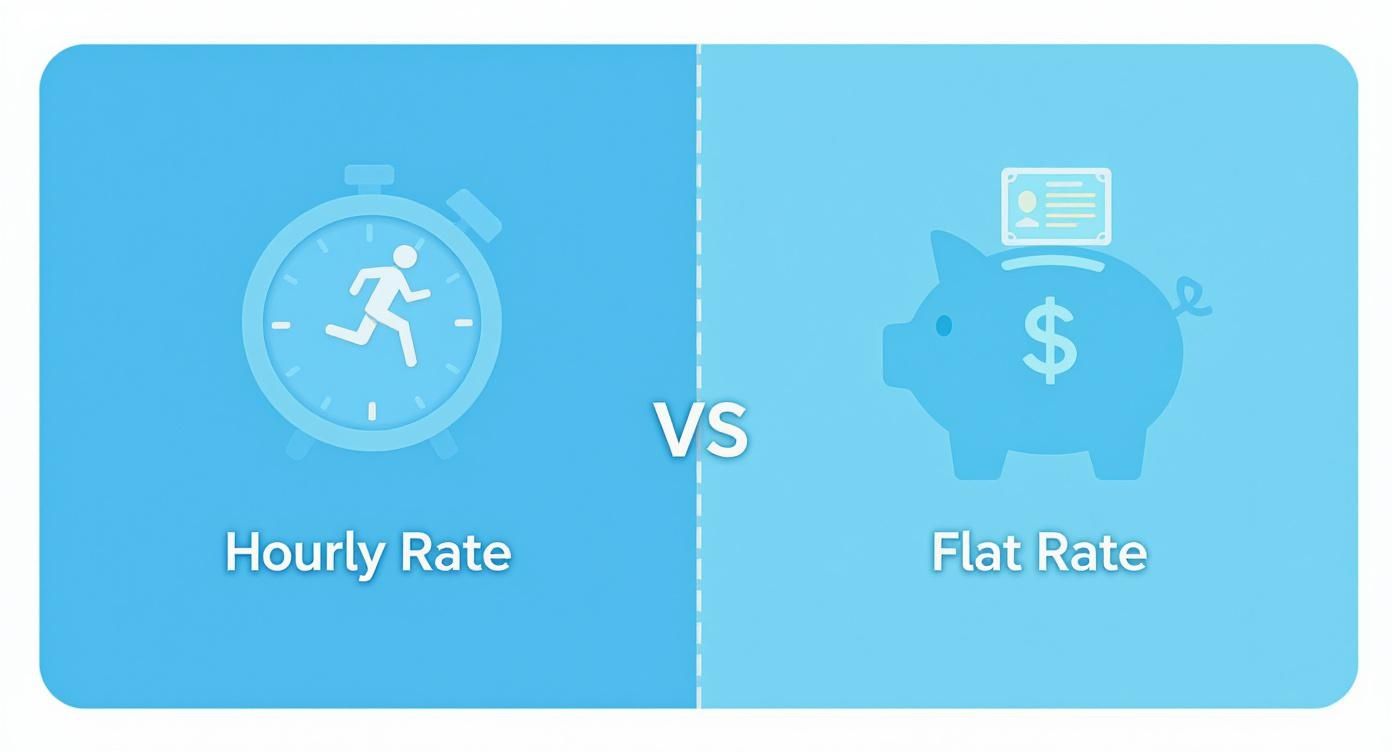
As you can see, a flat rate gives you peace of mind with a set cost, while an hourly rate can change depending on project delays or other on-site surprises.
Finally, we have to consider team size, which is especially important for bigger projects. Safely and efficiently assembling a heavy piece of fitness equipment or a large outdoor playset is almost always a two-person job. This makes sure the item is handled correctly without risking damage to your home or injury to our technicians. If a project needs more than one person, the quote will naturally reflect the cost of a larger team.
This reality is part of a much bigger trend. The global services market, which was valued at around $17.45 trillion in 2025, is expected to balloon to $24.03 trillion by 2029. That’s a massive jump, and it shows just how much people are valuing expert, reliable help for tasks big and small. You can dig into more of the data on this global services boom over at ResearchAndMarkets.com.
Knowing the factors that influence assembly cost is one thing, but seeing how they play out in the real world makes it all click. To give you a better feel for what to expect, let's walk through some common assembly jobs and their typical flat-rate costs.
These examples pull back the curtain on how we arrive at a final price, factoring in the job's complexity, the need for a second technician, and the time we expect it to take. It's all about transparency, so you can see exactly what you're paying for when you get a quote. For an even deeper dive into furniture-specific numbers, check out our full guide on the cost to assemble furniture.
To make this even clearer, here are a few sample quotes for projects we handle all the time. This table shows how our flat-rate pricing works for different types of jobs, from a simple desk to a complex multi-station gym.
| Project Scenario | Estimated Flat-Rate Cost | Key Cost Factors |
|---|---|---|
| IKEA PAX Wardrobe | $350 – $600+ | Two-person team needed for heavy panels; 4-6 hour build; hundreds of parts and precise door alignment. |
| 14-ft Outdoor Trampoline | $150 – $350 | Specialized spring-pulling tools; meticulous safety checks; 2-3 hour assembly time. |
| Multi-Station Home Gym | $250 – $500 | Intricate cable routing and pulley systems; requires 3-5 hours and functional testing for safety. |
As you can see, the final cost isn't just about the time spent but also the skill, tools, and team size required to get the job done right and safely.
A multi-unit IKEA PAX system, especially one with sliding doors and custom interior organizers, is one of the more challenging furniture assemblies out there. It’s a job that demands precision, a ton of patience, and almost always a second set of hands to lift and position those big, heavy panels without damaging them or your walls.
Putting together a big, 14-foot trampoline with a full safety net is a job where you absolutely cannot cut corners. The process involves stretching springs under serious tension and getting the enclosure just right—tasks that can be surprisingly tricky and even a bit risky if you don’t know what you’re doing.
The cost of a professional service isn't just for the labor; it’s an investment in getting the job done right and safely. For items like trampolines or fitness equipment, correct assembly is crucial for preventing accidents and injuries down the line.
A multi-station home gym is another beast altogether. With all its moving parts, cables, pulleys, and weight stacks, proper assembly is the difference between a great workout and a potential disaster. Similar cost considerations apply to other complex home installations. For a good comparison, you can see how much it costs to install cabinets, which also involves precision and expertise.
When you're trying to figure out how much a service costs, it’s only natural to focus on what you can see—the technician's time and labor building your item. But a quote from a professional company like Assembly Smart includes something just as valuable, even if you can't see it: protection. These safeguards are your guarantee that the experience will be risk-free and professional from the moment we walk in the door.
Think about what could happen if you hire a random person from an online marketplace. If they accidentally scratch your brand-new hardwood floors while putting together a desk or, even worse, get hurt on your property, you could be on the hook for the costs. Suddenly, that "cheaper" option becomes a financial nightmare.
A professional service provider takes all that risk off your shoulders. The price you pay is an investment in your total peace of mind, knowing you’re fully protected from any unexpected accidents.
This protection really comes down to two key types of coverage, and both are non-negotiable for any reputable assembly company. It’s worth knowing what they cover, and you can learn more about the specific contractor insurance requirements that separate the pros from the hobbyists.
General Liability Insurance: Think of this as your shield against property damage. If a technician accidentally drops a heavy part and puts a dent in your wall, this insurance covers the repairs. It makes sure that any "oops" moments don't come out of your wallet.
Worker's Compensation: This protects everyone if a technician gets hurt on the job. It covers their medical bills and lost wages, which means you are never liable for injuries that happen on your property.
When you hire an insured service, you aren't just paying for assembly; you're paying for accountability.
A professional quote isn't just a fee for building something—it’s a comprehensive guarantee of safety, accountability, and professionalism. It transforms the service from a simple task into a worry-free solution for your home.
So, when you get a quote that includes these protections, you’re buying more than just a finished product. You're getting a promise that the job will be done safely and that your home and the technicians are covered, no matter what happens. It's a foundational part of a high-quality service and a huge reason why a professional quote reflects true value, not just the lowest price.
Now that you know how assembly services are priced, you can find some clever ways to save a few bucks. While a flat-rate fee is great for avoiding surprise costs, a little bit of prep work can actually bring your initial quote down and make the whole process go a lot smoother.
Think about it this way: the less time a technician has to spend on non-assembly tasks, the better the value for you. A few minutes of your time beforehand can make a real difference.
Here are four easy things you can do to get the best possible price on your next project.
Prepare Your Workspace
Before the technician even rings your doorbell, clear out the room where the item will live. That means scooting other furniture out of the way, running the vacuum, and just making sure there’s plenty of elbow room to work. Why it works: Your technician can get straight to building instead of spending time (which would be billable on an hourly job) just clearing a space to work.
Unbox and Organize All Parts
This one is huge. Go ahead and open up the box and lay out all the pieces. If you really want to be a hero, group the similar screws and bolts together. It might seem small, but it can shave a surprising amount of time off the build. Why it works: It turns a frustrating hunt for “Part F” into a simple, grab-and-go assembly.
It’s the small prep tasks that add up. When you handle the simple stuff, you let the pro focus on the skilled work they’re there to do. That’s where you get the real value for your money.
Being proactive with information is your best friend when getting a quote. The more we know upfront, the more accurate—and often lower—your estimate will be.
Be Specific With Your Request
Always give us the exact product name, model number, or a link to the item you bought. A vague request like "a big dresser" forces an estimator to guess high to cover any potential curveballs. Why it works: A precise model number lets us pull up the exact assembly manual. No guesswork, just a firm, accurate flat-rate quote.
Bundle Multiple Jobs
Got more than one item that needs building? Book them for the same day. Most services, including us here at Assembly Smart, can offer a better price for bundled projects. Why it works: It's a win-win. We save on travel time and logistics, and we’re happy to pass those savings on to you.
To wrap things up, let's go over a few common questions that pop up when you're planning for an assembly service. Getting these answers sorted out ahead of time makes the whole process go a lot smoother.
It's one of those frustrating moments—you open the box, and a crucial piece is cracked or just plain gone. If one of our technicians discovers this, the first thing they'll do is document the issue and let you know right away.
In most cases, we have to pause the job until you can get a replacement part from the manufacturer. Because we stick to our flat-rate pricing, you won't be charged for this downtime while you wait.
We definitely recommend being there when the technician arrives. That way, you can show them exactly where you want the item built and discuss any specifics. It's also a good idea to be there at the end to give the final assembly a once-over and make sure you're happy with it.
You don’t have to stick around for the entire appointment, though, as long as our assembler has safe access to the workspace.
The real beauty of a flat-rate service is that the price is for the completed job, not how many minutes it takes. If our technician is a pro and gets it done faster than expected, the price you were quoted is the price you pay. You get the full value, no matter what.
Tipping is never expected, but if you're thrilled with the service, it's always appreciated. For more quick answers on service details and costs, you might find what you're looking for on a dedicated Frequently Asked Questions (FAQ) page.
Ready to skip the instruction manual headache and get your stuff built right? Let Assembly Smart take care of it with a clear, upfront flat-rate quote.