-
CALL US:
- (866) 952-3456

Before you even think about unwrapping those parts, let's be real: a successful build starts with a solid plan. Trying to follow the metal bed frame instructions is a whole lot easier when you've prepped your space, made sure all the pieces are actually in the box, and gathered the right tools.
This initial setup is the secret to a frustration-free assembly. Trust me on this.
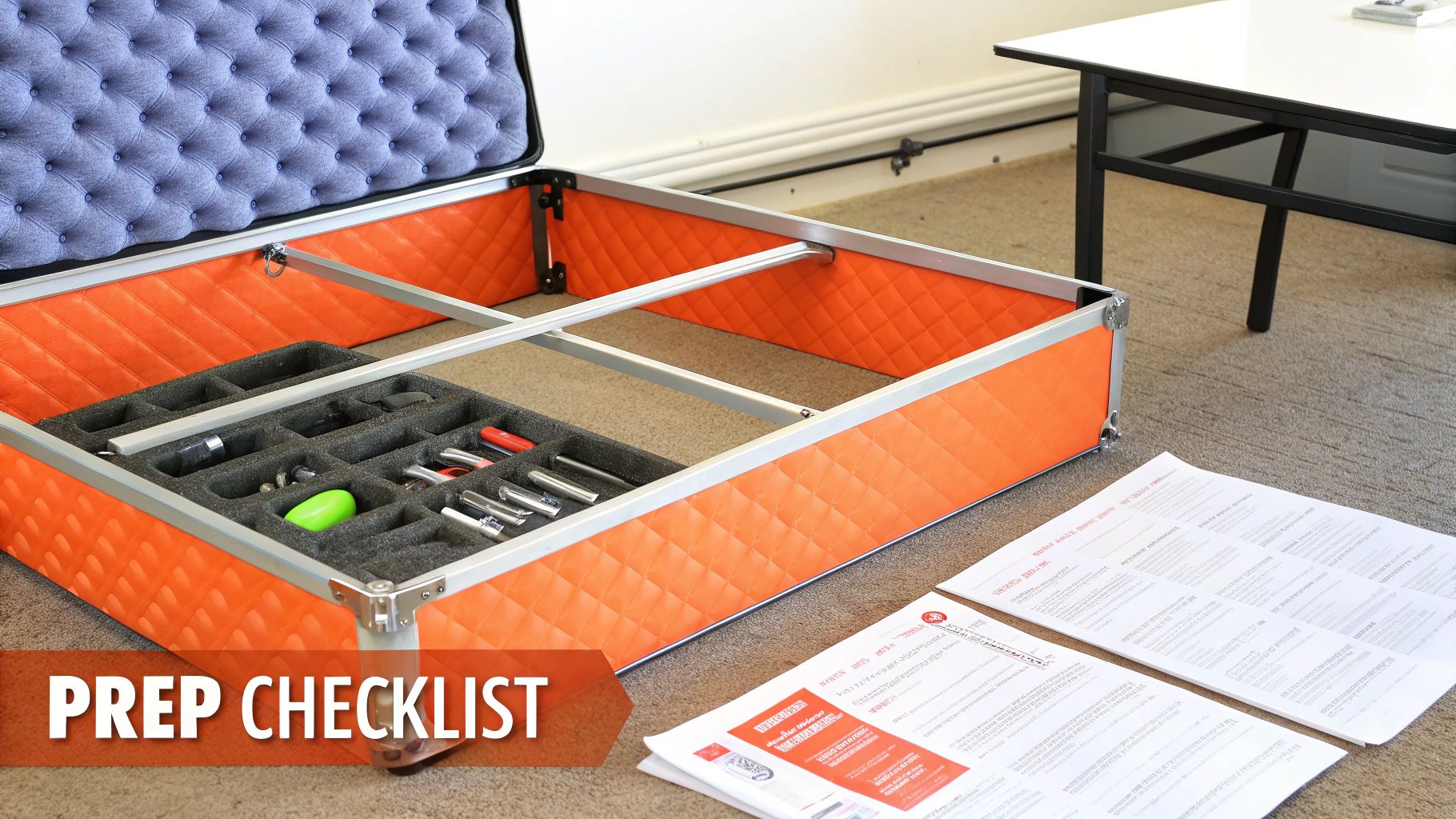
The excitement of a new bed can make you want to tear open the box and dive right in, but a few minutes of prep work now can save you hours of headaches later. Think of this as creating your mission control. The goal is to make the entire process smoother, safer, and way more efficient.
First thing's first: clear out a good-sized workspace in the room where the bed will actually live. Building it in place saves you from the awkward—and potentially frame-damaging—shuffle of moving it later. Lay down a blanket or the flattened cardboard box to protect both your floors from scratches and the bed frame's finish from scuffs.
Once your area is prepped, open the hardware pack and lay out every single screw, bolt, and washer. Carefully compare what you have against the parts list in the manual. Catching a missing piece now means a quick call to customer service, not a project-stopping disaster midway through the build.
This simple inventory check is a non-negotiable step. It ensures you have everything you need before you commit.
Pro Tip: Use a muffin tin or a few small bowls to sort the different types of hardware. Slapping some masking tape on them with labels (e.g., "Bolt A," "Screw #5") keeps you from grabbing the wrong one and potentially stripping a thread.
Next up, gather your tools. While that little Allen key they include technically works, a few extra items can make a world of difference.
A proper toolkit turns a chore into a straightforward task. While the manufacturer provides the basics, having these on hand will make you feel like a pro.
Gather these required and recommended tools for a much smoother assembly experience.
| Tool | Why It's a Game-Changer | Pro Tip from an Assembler |
|---|---|---|
| Ratcheting Screwdriver | Saves your wrist and cuts down tightening time significantly. | Make sure you have a set with interchangeable hex bits that match the bolts. |
| Rubber Mallet | Perfect for tapping stubborn parts into place without denting the metal. | A gentle tap is all you need. Never use a metal hammer—it will mar the finish. |
| Level | Ensures your frame is perfectly flat, preventing squeaks and wobbles later. | Use it on the side rails and headboard before you fully tighten everything. |
| Work Gloves | Protects your hands from sharp metal edges and improves your grip. | A good-fitting pair is worth its weight in gold. |
Having the right gear ready is a key part of preparing for your furniture assembly project; it's about setting yourself up for success from the get-go.
The demand for durable and stylish metal furniture isn't slowing down. In fact, the global market is projected to grow from USD 96.3 billion to a whopping USD 139.9 billion by 2035. Proper assembly is what ensures these long-lasting pieces stay sturdy and reliable for years to come.
Let's be real: most furniture manuals look like a test you didn't study for. They’re usually just a wall of diagrams loaded with cryptic arrows, letters, and numbers. But learning how to decode these visual guides is the single most important skill you can have for a smooth assembly.
Think of it less like a book and more like a map. Before you touch a single screw, spend a few minutes just flipping through the entire manual. Get a feel for the flow of the build, seeing how the small bits and pieces eventually come together to form the final bed frame. This quick fly-over prevents a lot of nasty surprises down the road.
The instructions for most metal bed frames are almost all pictures. The tiny details in each diagram are where all the critical information is hiding, so you have to pay close attention.
The real secret to a calm, stress-free build is hardware organization. I can't stress this enough. By sorting all your screws, bolts, and washers into labeled containers before you start, you completely eliminate that frantic search for "Bolt #5" while you're trying to hold two heavy metal pieces in place.
For those of you who get a kick out of this stuff and want to tackle more complex projects, these skills transfer surprisingly well. For instance, the core principles behind understanding detailed construction blueprints are very similar—it’s all about interpreting symbols and orientations to build a stable structure.
Okay, let's picture a tricky step. Imagine a diagram showing two side rails (Part C) that need to connect to a headboard leg (Part A) using two different bolts (#3 and #4). The drawing probably looks crowded and confusing, but the key is to focus on one connection at a time.
First, figure out the top and bottom of the leg based on the other holes shown in the picture. Next, find the matching holes on the side rail. The manual will have a line drawn from Bolt #3 to a specific hole and another line from Bolt #4 to a different hole. Only use those bolts in those exact spots. This methodical, one-thing-at-a-time approach breaks a complicated step down into simple, manageable actions.
If you find yourself getting tripped up by different manuals from various brands, it can help to review a bunch of furniture assembly instructions to get familiar with the common patterns they use.
Alright, now for the fun part—watching your new bed actually start to look like a bed. This is where we build the core foundation. Trust me, spending a little extra time here to get everything solid and square is the secret to a bed that doesn't wobble or squeak down the line. It really pays off.
The first major move in most instruction manuals is attaching the legs to the headboard and footboard. If you're flying solo, this can feel a bit like wrestling an octopus. Here's a pro tip: lean the headboard against a wall. This simple trick gives you a stable base to work from, freeing up both hands to line up the leg pieces and get the bolts in without trying to balance the whole thing at once.
With the headboard and footboard standing (more or less), it's time to bring them together with the long side rails. This is a make-or-break moment. Misaligned rails are the number one reason beds start squeaking and feeling rickety, so it’s worth the effort to nail this part.
This is where a technique we use all the time comes into play: the hand-tighten first rule. Seriously, do not crank down on any bolts just yet.
This simple process—identify, sort, and match—makes those sometimes-confusing diagrams in the manual a lot easier to follow.

Breaking the job down into these small, manageable tasks is the key to not feeling overwhelmed by a complex set of instructions.
As you get the rails in place, you'll see different ways they're designed to connect. The most common are simple bolts that go straight through the frame or hook-in slots that are designed for a faster, drop-in assembly.
A strong, well-aligned connection is the heart of a durable bed frame. When the side rails slot perfectly into the headboard and footboard, the frame can properly distribute weight and resist the subtle movements that lead to noise over time.
For anyone who wants to get a better handle on the tools for the job, our guide to essential furniture assembly tools can show you which ratchets or hex bits might speed things up. It’s no surprise that North America commands about 39% of the global bed frame market, which is expected to hit around USD 24.36 billion in 2025. With so many people buying these beds, you can see why clear instructions are so important.
Once all the main parts are connected and hand-tightened, give the frame a little shake. This helps it settle into a naturally square position. You should now have something that looks like a bed frame, standing on its own and ready for the final tightening.
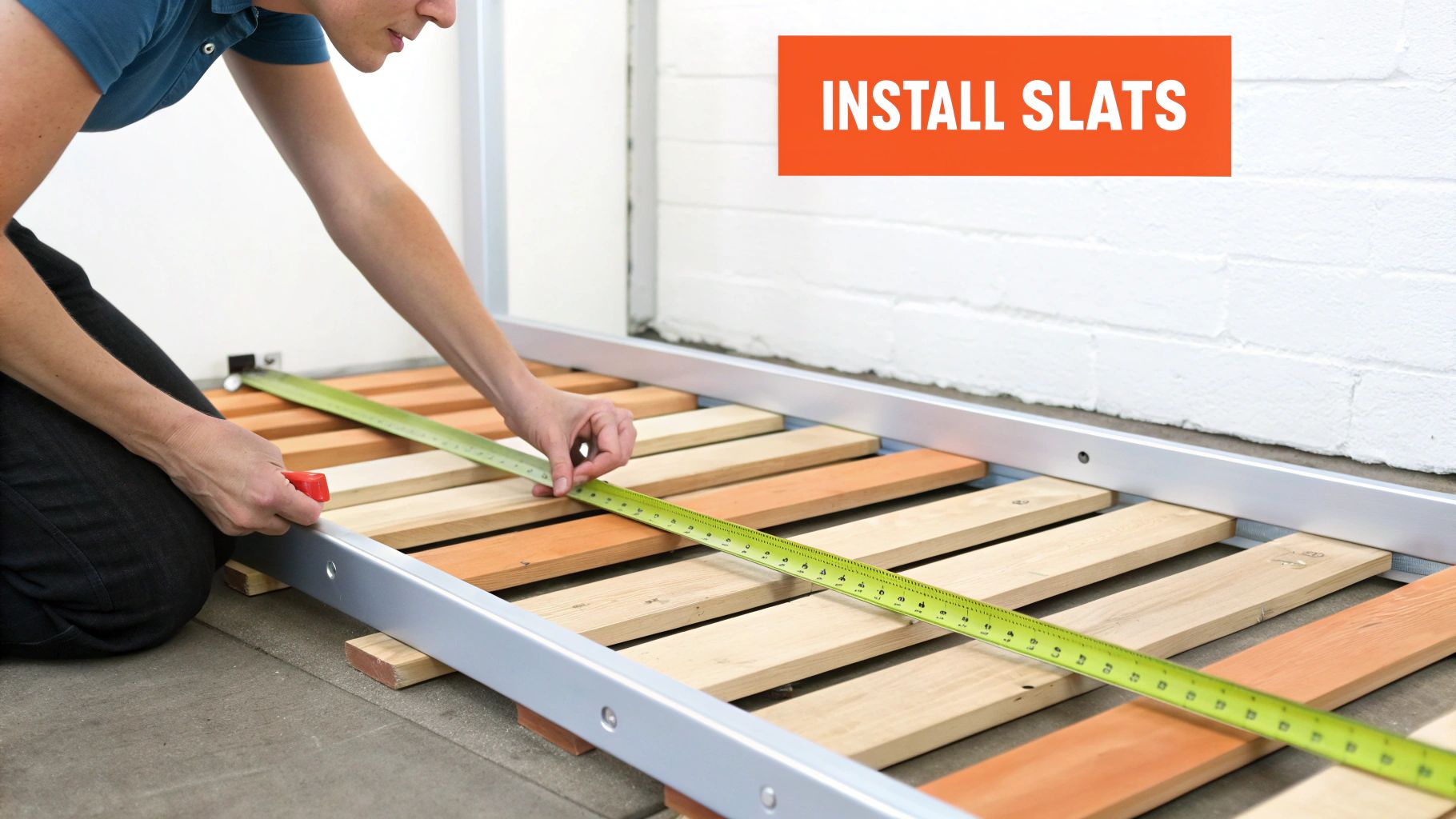
With the main frame standing tall, you've hit a point where a lot of people get impatient and just want to finish: building the mattress support system. But let me tell you from experience, getting this part right is the difference between a silent, sturdy bed and one that sags, groans, and squeaks with every move.
The type of support your frame uses—whether it's wooden slats, metal bars, or a wire grid—will change how you tackle this. Each style has its own little tricks, and skipping over them is a recipe for a bad night's sleep.
Most metal bed frames you'll encounter use one of a few common systems. Wooden slats usually need to be spaced out and screwed in, while their metal counterparts might just snap or bolt into place. Then you have wire grids, which often just unfold and sit on the frame's inner ledge.
Here’s what I've learned to watch out for with each type:
Proper slat installation is non-negotiable for the health of your mattress. Most mattress warranties today get specific, requiring a gap of no more than 2.75 inches between slats. Go wider than that, and you're risking premature sagging and a denied warranty claim.
If you're building a full-size frame or larger, you'll almost certainly see one or more center support legs. These are not optional. Think of them as the single most important defense against that dreaded mattress dip in the middle.
Once your slats are in place, it’s time to adjust these legs. You want to extend them just enough so they make firm, solid contact with the floor. The big mistake people make is over-extending them, which lifts the center rail and creates a hump in your bed.
The goal is for the center support leg to bear weight, not lift the frame. It should sit flush and unmoving on the floor. If you can slide a piece of paper under it, it's too high. A perfectly adjusted leg prevents the dreaded "taco bed" effect.
After the leg is touching the floor, tighten any locking nut or screw to hold it firmly in place. Taking a minute to get this detail right is one of the most impactful steps in the entire set of metal bed frame instructions, ensuring your bed stays level and supportive for years to come.
Alright, you're in the home stretch. The frame is standing and actually starting to look like a bed, but don't get ahead of yourself. This next part is arguably the most important for making sure your new frame is quiet and lasts for years.
It’s time for the final pass. You're going to go back and methodically tighten every single bolt and screw you've put in. This is a non-negotiable step. It’s what takes a slightly wobbly structure and turns it into a rock-solid, unified piece of furniture.
Think of it like this: the "hand-tighten first" approach was all about getting the alignment just right. Now, this final tightening locks that perfect alignment in place. It closes up all the tiny gaps that are the root cause of squeaks and shifting down the road. Go back to the very first bolts you installed and work your way through the assembly sequence, giving each one a firm, final turn with your Allen key or ratchet.
Once you're confident every connection is good and snug, it's time for the all-important wobble test. Grab the headboard and then the footboard and give the frame a solid shake from a few different angles. Does it feel like a single, solid unit? Or can you feel a little bit of give or hear a faint click?
Any movement, no matter how small, is a dead giveaway that a connection is still loose. Try to pinpoint exactly where the motion is coming from and give that specific joint one more quarter-turn. In my experience, it's usually a corner connection or one of the bolts on a center support rail that needs that last little bit of a tweak.
A truly stable bed frame shouldn't have any independent movement between its parts. The goal is to make the entire structure react as one piece. This final check is what ensures your hard work results in a secure, silent, and stable bed for years to come.
Getting these final details right is crucial, especially for more complex frames. It's interesting to see how search trends for things like metal bunk beds always seem to spike around August, which tells us a lot of people are tackling these projects during the hectic back-to-school season. Having a reliable process for this final safety check is key, no matter the design. You can actually see more insights on these consumer trends from Accio.com.
With everything tightened, go ahead and move the bed into its final spot in the room. Now, grab your level and place it on the side rails. Is that bubble sitting perfectly in the middle? You'll want to check this along both the length and the width of the frame.
If it's not perfectly level, it can put uneven stress on the joints over time, which eventually leads to annoying noises and instability. More often than not, uneven floors are the culprit. If you find your frame isn't level, the fix is usually pretty simple. You can slide furniture shims or use adjustable leveling feet under the leg that needs a boost. Just raise it slightly until the bubble on your level is dead center.
For a more detailed walkthrough on this, check out our guide on how to level furniture on uneven floors. This last adjustment is what ensures your mattress lies perfectly flat, giving you the best support and preventing any of those frustrating wobbles.
Even when you have the instructions laid out, a few questions always seem to pop up during a build. It’s totally normal. Knowing the answers to these common little hurdles ahead of time can be the difference between a frustrating afternoon and a quick, satisfying assembly.
Let’s walk through some of the most frequent challenges people run into, so you can handle them like you’ve done this a hundred times.
For a standard queen or king frame, plan on giving yourself 1 to 2 hours if you're tackling it alone. That gives you enough breathing room for unboxing, laying out all the parts, the build itself, and cleanup. If you bought something more complex, like a canopy bed or a bunk bed, you can expect that to stretch to 3-4 hours simply because of all the extra pieces and connections.
Want a simple way to speed things up? Grab a friend. Having a second pair of hands to hold the headboard steady or align the side rails can seriously cut your assembly time by 30-40%.
This is probably the most common issue people face, but it's rarely a defect from the factory. The first thing you should do is check that all the other bolts in that same section are still a little loose. This gives you the wiggle room you need to nudge the parts into perfect alignment.
If it’s still not lining up, just take a breath and double-check that you're using the right parts for that step—and that they aren’t backward or upside down. A gentle tap from a rubber mallet can also sometimes persuade a stubborn piece into place without leaving a mark.
A misaligned hole is almost always a sign that the frame needs to settle. By keeping all connections loose until the very end, you allow the entire structure to shift into its natural, square position, which makes lining up the final bolts much easier.
Yes, but you have to be careful. A power drill is a huge time-saver, but always, always use it on its lowest torque setting. Overtightening a screw with a drill is the quickest way to strip it or, worse, damage the frame itself. That can mess with the bed's stability down the line.
The best approach is to use the drill to drive the screws about 90% of the way in. Then, switch over to the Allen key they gave you or a regular screwdriver to do the final tightening. This gives you total control and helps you avoid a costly mistake. If you’re thinking ahead about future moves, getting some tips on how to move heavy furniture is a smart idea.
A squeaky frame is almost always caused by a loose joint somewhere. Before you do anything else, go back and systematically re-tighten every single bolt on the frame. Pay close attention to the corners where the side rails connect to the headboard and footboard, as these are the usual suspects.
If the squeak is still there, try to pinpoint the exact joint making the noise. Then, loosen its bolt, slip a small plastic or felt washer between the two metal parts, and tighten it back up. This tiny bit of cushioning creates a buffer that can stop friction-based noises completely.
Feeling like you've bitten off more than you can chew with all these instructions and tiny parts? The experts at Assembly Smart can have your new bed frame put together perfectly in no time, with insured and guaranteed service. Get your free estimate and book a fast, stress-free assembly today at https://assemblysmart.com.